TL;DR:
- Managing social security for cross-border employees involves complex, detail-oriented compliance with EU regulations.
- Proper documentation, timely A1 certificates, and ongoing monitoring are key to avoiding penalties.
- Internal coordination, proactive audits, and expert support help organizations navigate operational challenges.
Managing social security registration for cross-border employees is one of the most technically demanding responsibilities in international HR. A single misclassification, a late filing, or a missing Portable Document A1 certificate can expose a company to back contributions, penalties, and reputational risk across multiple jurisdictions. The EU regulatory framework governing this area is detailed and, in practice, more nuanced than official summaries suggest. This guide walks HR managers and compliance officers through the foundational rules, required documentation, registration procedures, and ongoing compliance obligations that apply when deploying or receiving cross-border workers within the European Economic Area.
Key Takeaways
| Point | Details |
|---|---|
| One-country rule applies | EU legislation ensures each cross-border employee is subject to only one country’s social security system. |
| A1 certificate is essential | Get a PD A1 document for posted workers or remote telework to prove social security coverage. |
| Check regulations for each scenario | Rules differ for posted, expatriate, multi-state, and teleworker cases—prepare accordingly. |
| Track compliance post-registration | Keep detailed records and monitor compliance to avoid penalties and support future audits. |
Understanding EU social security regulations
The EU established a coordination framework for social security to prevent workers from either falling through the gaps between national systems or being subject to double contributions in two countries simultaneously. The core principle is straightforward: one worker, one applicable legislation at any given time.
EU social security coordination for cross-border workers and expatriates is governed by Regulation 883/2004 and its implementing counterpart, Regulation 987/2009. These regulations establish four foundational principles:
- Equal treatment: Workers are entitled to the same social security benefits as nationals of the country whose legislation applies.
- Aggregation: Periods of insurance, employment, or residence in different member states are combined when determining entitlement to benefits.
- Single applicable law: Only one member state’s legislation applies at a time, eliminating the risk of dual contributions.
- Exportability: Certain benefits, such as pensions and unemployment payments, can follow the worker across borders.
The regulations apply to EU nationals, stateless persons, and refugees residing in member states, as well as their family members and survivors. They also extend to EEA countries (Norway, Iceland, Liechtenstein) and Switzerland under separate bilateral agreements.
“The coordination framework does not harmonize national social security systems. Each member state retains its own rules on contribution rates, benefit levels, and qualifying conditions. The regulations only determine which country’s rules apply.”
The following table summarizes the primary regulations and their scope:
| Regulation | Role | Scope |
|---|---|---|
| Regulation (EC) No 883/2004 | Core coordination rules | EU/EEA nationals, cross-border workers |
| Regulation (EC) No 987/2009 | Implementing procedures | Administrative cooperation between states |
| Bilateral agreements | Country-specific rules | Non-EU nationals in some cases |
Understanding these foundations is essential before any registration process begins, because the applicable legislation determines where contributions must be paid and which authority must be notified.

Key requirements and documents for social security registration
With the legal framework established, the next step is identifying what must be prepared before initiating registration. The default rule is lex loci laboris: social security contributions are due in the country where work is physically performed, and employers must register workers with local social security authorities in the host country unless a recognized exception applies.
The documentation requirements vary depending on the employee’s classification. The four main categories are:
- Standard host-country employee: Registered directly with the host country’s social security authority using local forms and employer registration numbers.
- Posted worker: Requires a PD A1 certificate from the home country authority before posting begins; no host-country registration needed for social security.
- Multi-state worker: Requires determination of applicable legislation based on residence and activity percentages, followed by A1 issuance.
- Remote or telework employee: Subject to the Framework Agreement rules or standard lex loci laboris depending on the share of work performed in each country.
For A1 certificate requirements, HR must prepare the following core documents regardless of employee type:
- Employee’s passport or national identity document
- Employment contract specifying work location(s) and duration
- Employer’s registration details in the home country
- Evidence of the employee’s social insurance history (where applicable)
- Completed application forms for the relevant national authority
For companies registering in Romania, the process involves filing with the National Agency for Fiscal Administration (ANAF) and the relevant social insurance house (Casa de Pensii).
| Employee type | Registration location | Key document |
|---|---|---|
| Local hire | Host country | Employer registration + contract |
| Posted worker | Home country only | PD A1 certificate |
| Multi-state worker | Residence state (if ≥25% activity) | A1 certificate |
| Remote/telework | Depends on telework percentage | A1 or host-country filing |
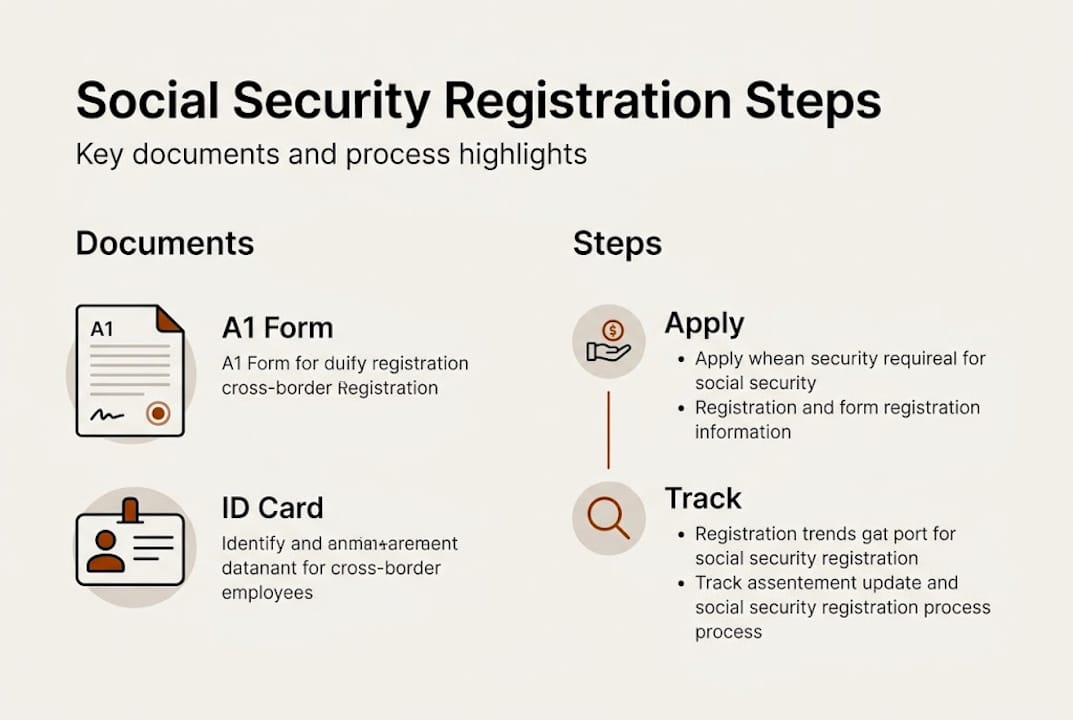
Pro Tip: Always initiate the A1 application process at least four to six weeks before a posting or assignment begins. Many national authorities have processing backlogs, and starting work without a valid A1 in place is one of the most common compliance failures encountered during cross-border inspections.
Step-by-step registration process for cross-border employees
With documentation in order, the registration process follows distinct paths depending on the employee’s category. Here is how each scenario unfolds in practice.
For standard host-country employees:
- Register the employing entity with the host country’s social security authority before or at the start of employment.
- Enroll the employee using the applicable national registration form.
- Obtain confirmation of registration and retain the reference number for payroll and audit purposes.
- Begin contribution payments according to the host country’s schedule.
For posted workers:
Employers can post workers temporarily for up to 24 months, extendable to 36 months in some cases, while maintaining coverage under the home country’s social security system. This is confirmed through the PD A1 certificate, which must be obtained from the home country’s social security institution before the posting starts.
- Confirm the posting meets all conditions: the employer must carry out substantial activity in the home country, and the worker must have been subject to home-country legislation immediately before posting.
- Submit the A1 application to the competent home-country authority.
- Receive and retain the PD A1 certificate.
- Notify the host country’s labor or social security authority as required under local posting rules.
- Monitor the posting duration and initiate an extension request if the assignment is expected to exceed 24 months.
For A1 certificate changes introduced in recent years, including updates to electronic processing and cross-border verification, HR teams should review current national authority guidance before filing.
Statistic callout: According to enforcement data, late or missing A1 certificates are among the most frequently cited violations during labor inspections of posted workers across EU member states.
Pro Tip: Keep a centralized tracker for all active A1 certificates, including issue dates, expiry dates, and the responsible national authority. This single tool prevents the most common audit failure: being unable to produce a valid A1 on short notice during a host-country inspection.
Special cases: Multi-state, remote, and telework scenarios
Some employee arrangements do not fit the standard posted worker or local hire model. Multi-state workers and cross-border teleworkers require a separate analytical framework before any registration or A1 application can proceed.
Multi-state workers are those who habitually work in two or more EU member states. The applicable legislation is determined as follows:
- If the worker performs 25% or more of their activity in their state of residence, that state’s legislation applies.
- If the worker performs less than 25% in the residence state, the employer’s registered state’s legislation applies.
- If there are multiple employers in different states, additional rules apply based on residence and employer location.
For cross-border telework, the Framework Agreement introduced in 2023, now covering 23 or more signatory countries, allows employees to telework from their residence country for up to 49.99% of their total working time while remaining covered under the employer’s state social security system. This is formalized through a joint A1 request submitted by both employer and employee.
| Scenario | Applicable legislation | Required document |
|---|---|---|
| Multi-state, ≥25% in residence | Residence state | A1 from residence state |
| Multi-state, <25% in residence | Employer’s state | A1 from employer’s state |
| Telework ≤49.99% in residence | Employer’s state | Joint A1 under Framework Agreement |
| Telework >50% in residence | Residence state | Standard registration in residence state |
Key compliance considerations for these scenarios include:
- Documenting actual work location percentages with timesheets or calendar records
- Reviewing Framework Agreement participation status for both the employer’s and employee’s countries
- Reassessing applicable legislation whenever an employee’s work pattern changes materially
- Ensuring expatriate compliance reviews are conducted at least annually for multi-state workers
“The Framework Agreement is not automatic. Both the employer and employee must actively request the joint A1, and the competent authority in the employer’s state must approve it. Failure to do so means the residence state’s legislation applies by default.”
Verification, record keeping, and ongoing compliance
Registration is not the end of the compliance cycle. Employers must register workers and maintain compliance as required under lex loci laboris or the applicable exception, and this obligation continues for the full duration of the employment relationship.
After completing registration, HR should take the following verification steps:
- Obtain written confirmation of registration from the relevant national authority
- Verify that the employee’s social security number or reference has been correctly assigned in the host country
- Confirm that payroll has been updated to reflect the correct contribution rates and deduction codes
- Cross-check that any A1 certificate on file matches the actual work arrangement in terms of dates and countries
For record keeping, the following documents should be retained for a minimum of five years, and in some jurisdictions longer:
- All registration filings and confirmation letters
- Copies of all PD A1 certificates, including expired ones
- Correspondence with national social security authorities
- Payroll records showing contributions paid in each jurisdiction
- Any exemption decisions or bilateral agreement applications
“Audit readiness is not a one-time event. Regulatory authorities in several EU member states have increased inspection frequency for cross-border employment arrangements, particularly for posted workers and telework scenarios.”
Pro Tip: Assign a named compliance owner for each cross-border employee or employee category. When responsibility is diffuse, critical renewal deadlines for A1 certificates and registration updates are frequently missed. For cross-border compliance best practices, a documented internal process is more reliable than relying on individual memory or informal tracking.
Ongoing compliance also requires proactive monitoring of regulatory changes. EU member states periodically update their national social security rules, contribution rates, and administrative procedures, and HR teams must integrate these updates into their mobility programs without delay.
Why social security compliance for cross-border teams is harder than it looks
The regulatory framework for EU social security coordination is, on paper, logical and well-structured. In practice, the gap between the written rules and operational reality is significant, and that gap is where most compliance failures occur.
One persistent challenge is the coordination lag between home and host HR teams. When a posting is agreed at the business level, the social security filing process often starts too late because no one has formally triggered it. By the time the A1 application is submitted, the employee may already be working in the host country without valid coverage documentation.
Another underappreciated risk involves employee misclassification. Workers who are treated as posted workers but who no longer meet the substantive activity test in the home country are technically subject to host-country legislation, even if an A1 has been issued. Issuing an A1 does not guarantee compliance if the underlying conditions are not continuously met.
For complex scenarios involving multi-state work, telework, or sequential assignments, the risk compounds. Clear internal checklists, regular audits of active assignments, and close coordination between HR, payroll, and legal are not optional enhancements. They are the minimum standard for organizations operating cross-border teams at any meaningful scale.
Get help with cross-border social security challenges
Navigating the intersection of EU coordination regulations, national filing requirements, and employee-specific exceptions requires both technical expertise and operational precision. For HR teams managing multiple cross-border assignments simultaneously, the administrative burden is substantial, and the cost of errors is higher than most organizations anticipate.
Nestlers Group provides end-to-end support for global mobility solutions, including social security registration, A1 certificate management, and ongoing compliance monitoring across EU jurisdictions. Whether you are deploying Romanian workers across Europe or managing inbound expatriates, Nestlers combines deep regulatory knowledge with structured workforce relocation programs to reduce risk and administrative overhead for your HR team.
Frequently asked questions
What is an A1 certificate and who needs it?
An A1 certificate proves that an employee remains covered by their home country’s social security system while working temporarily in another EU member state. It is required for posted workers and multi-state workers to confirm which country’s legislation applies.
How do you determine the correct country for social security contributions?
Contributions are generally owed in the country where the employee physically performs work, unless a valid exception applies, such as a posting arrangement supported by an A1 certificate or a telework agreement under the Framework Agreement.
What are the special rules for telework and multi-state workers?
For employees working across two or more states, the 25% residence rule determines applicable legislation, and the Framework Agreement allows up to 49.99% telework from the residence country without triggering a change in social security coverage, provided a joint A1 is obtained.
Which records do employers need to keep for social security compliance?
HR teams should retain all registration filings, A1 certificates, payroll records, and authority correspondence for at least five years, as ongoing employer obligations require demonstrable evidence of compliance throughout the employment relationship.
Recommended
Connect with Nestlers consultants
Do you need immigration and relocation services or consultancy?
It’s easy! Use the below contact form and one of our experts will provide you an answer as soon as possible.
Our consultants can help you in obtaining legal documents and can provide you with assistance regarding the immigration processes, relocation, taxes and payroll, Social Security (European forms A1, S1, U1, etc.) for your employees.