
Many HR leaders operate under the assumption that engaging an employer of record service transfers all employment-related risk to a third party. This assumption, while understandable, is factually incorrect and can expose organizations to significant compliance failures across European jurisdictions. An EOR does restructure the legal employment relationship, but the client company retains direct responsibility for how it directs, manages, and instructs its workforce. This article examines what EOR services actually do, how European regulatory frameworks shape their use, what criteria HR leaders should apply when selecting a provider, and how these solutions can support genuine organizational growth when deployed correctly.
Key Takeaways
| Point | Details |
|---|---|
| EOR clarifies liability | Employer of record solutions shift compliance burden but clients still direct employment. |
| Own-entity providers reduce risk | Selecting providers with local registration minimizes subcontracting and regulatory exposure. |
| European law requires diligence | Compliance rules like Germany’s AÜG make provider vetting and contractual clarity essential. |
| Global talent scalability | EOR enables faster hiring and expansion across borders without complex legal setups. |
What is an employer of record service?
An employer of record (EOR) is a third-party organization that assumes the legal role of employer for a worker on behalf of a client company. In practical terms, the EOR handles payroll processing, tax withholding, social security contributions, employment contracts, and statutory compliance, while the client company retains operational control over the employee’s day-to-day activities and deliverables.
This model is particularly relevant for companies seeking to hire talent in countries where they have no registered legal entity. Rather than incorporating a subsidiary, which can take months and require substantial capital, the client engages an EOR service to employ the worker locally and immediately. The arrangement allows the client to be operational in a new market within days rather than quarters.
It is important to distinguish EOR from related but structurally different models:
| Model | Legal employer | Client control | Entity required |
|---|---|---|---|
| EOR | Third-party EOR | Operational only | No |
| PEO | Shared (co-employment) | Operational and HR | Often yes |
| Subsidiary | Client company | Full | Yes |
| Staffing agency | Agency | Limited | No |
The EOR model is not equivalent to a professional employer organization (PEO), where co-employment arrangements are common and the client often shares legal employer status. Nor is it equivalent to creating a wholly owned subsidiary, which confers full legal control but demands significant administrative infrastructure.
Critically, EOR shifts not eliminates risk: clients remain liable for employment direction. This means that if a client instructs an employee in a manner that violates local labor law, such as requiring excessive working hours or failing to observe mandatory rest periods, the client organization bears direct exposure regardless of the EOR arrangement in place. HR leaders must internalize this distinction before structuring any international hiring program.
Key functions typically covered by an EOR include:
- Employment contract drafting and execution under local law
- Payroll processing and statutory deductions
- Social security registration and contributions
- Tax compliance and reporting
- Termination procedures in accordance with local regulations
- Benefits administration where legally mandated
Legal compliance and risk: Navigating European frameworks
Europe presents one of the most legally complex environments for EOR operations globally. Labor law is not harmonized across the EU; each member state maintains its own statutory framework, and multinational HR teams must account for significant variation in employment protections, termination rules, and regulatory oversight.
Germany is among the most rigorous jurisdictions. The Arbeitnehmerüberlassungsgesetz (AÜG), Germany’s labor leasing law, governs the placement of workers through third-party entities and imposes strict licensing, disclosure, and worker protection requirements. Germany’s AÜG law increases scrutiny but revised guidelines are supportive of compliant EORs that operate transparently and maintain proper licensing. This development is significant: it means EOR is a viable model in Germany, but only when the provider meets all statutory requirements and the client maintains appropriate oversight.
A critical structural consideration across all European markets is whether the EOR operates through its own directly owned local entities or relies on a network of subcontracted partners. The latter arrangement introduces a layer of legal and operational risk that is frequently underestimated. When subcontracting is present, accountability chains become diffuse, and the client may find that neither the primary EOR nor the subcontractor is fully accountable for a compliance failure.
“The use of subcontracted partner networks in EOR arrangements can create significant gaps in compliance accountability, particularly in jurisdictions with strict labor leasing regulations.”
For German payroll regulations and similarly demanding frameworks such as Austrian payroll compliance, best practices include the following:
- Verify that the EOR holds direct local registration and licensing in each hiring country
- Ensure employment contracts explicitly identify the EOR as the legal employer
- Establish a documented monitoring protocol to review payroll accuracy and statutory filings quarterly
- Maintain records of all employment direction instructions to demonstrate appropriate client conduct
- Confirm that the EOR’s local entity, not a partner, is named in all regulatory filings
For companies hiring through EOR compliance in Romania, Romanian labor law adds specific requirements around collective agreements, mandatory benefits, and notice periods that must be reflected accurately in employment contracts.
Pro Tip: Schedule formal compliance audits with your EOR provider at least twice per year. Request documentation of all statutory filings, tax registrations, and social security payments as part of a standard reporting cadence. Regulatory surprises are almost always the result of insufficient monitoring, not provider incompetence.
Choosing a provider: Essential criteria for HR leaders
Understanding local frameworks, the next step is evaluating which EOR provider is truly equipped for your needs. Provider selection is arguably the highest-stakes decision in the EOR process. A poorly structured provider relationship can generate more compliance exposure than operating without an EOR at all.
Prioritize owned-entity EORs over partners to avoid subcontracting risks. This principle should serve as the primary filter in any provider evaluation. The following structured criteria will guide a rigorous due diligence process:
- Entity ownership model. Confirm that the provider operates through directly owned legal entities in each country where you intend to hire. Request corporate registration documents as evidence.
- Compliance record and licensing. Review the provider’s licensing status in regulated markets such as Germany (AÜG license) and verify that no material regulatory sanctions have been issued in the past three years.
- Contract structure transparency. Examine the employment contract template used in each jurisdiction. It should clearly identify the EOR as the legal employer and reflect all local statutory requirements.
- Reporting and audit capabilities. Assess whether the provider can deliver structured compliance reports, payroll summaries, and statutory filing confirmations on a defined schedule.
- Regional expertise and operational depth. Evaluate the provider’s in-country legal and HR teams. Providers who rely solely on external legal counsel for routine compliance questions are a structural risk.
- Termination and dispute management. Understand the provider’s process for managing employee terminations, grievances, and labor disputes under local law. This is frequently where compliance failures surface.
Red flags to identify during due diligence include vague answers about subcontracting arrangements, inability to produce local entity registration documents, and reporting structures that lack clear accountability. The Romania EOR hiring guide provides a practical reference for what compliant provider arrangements look like in practice, and the tax and payroll solutions framework illustrates the depth of compliance infrastructure required.
Pro Tip: Select providers with direct local registration in every hiring country. A provider who claims coverage through a partner network in a jurisdiction with strict labor leasing laws is a liability, not an asset.
How EOR solutions drive business growth
Once the right provider is selected, it is important to examine the operational and strategic value that a well-structured EOR arrangement can deliver. The administrative and legal burden of international hiring is substantial, and EOR services address it systematically.

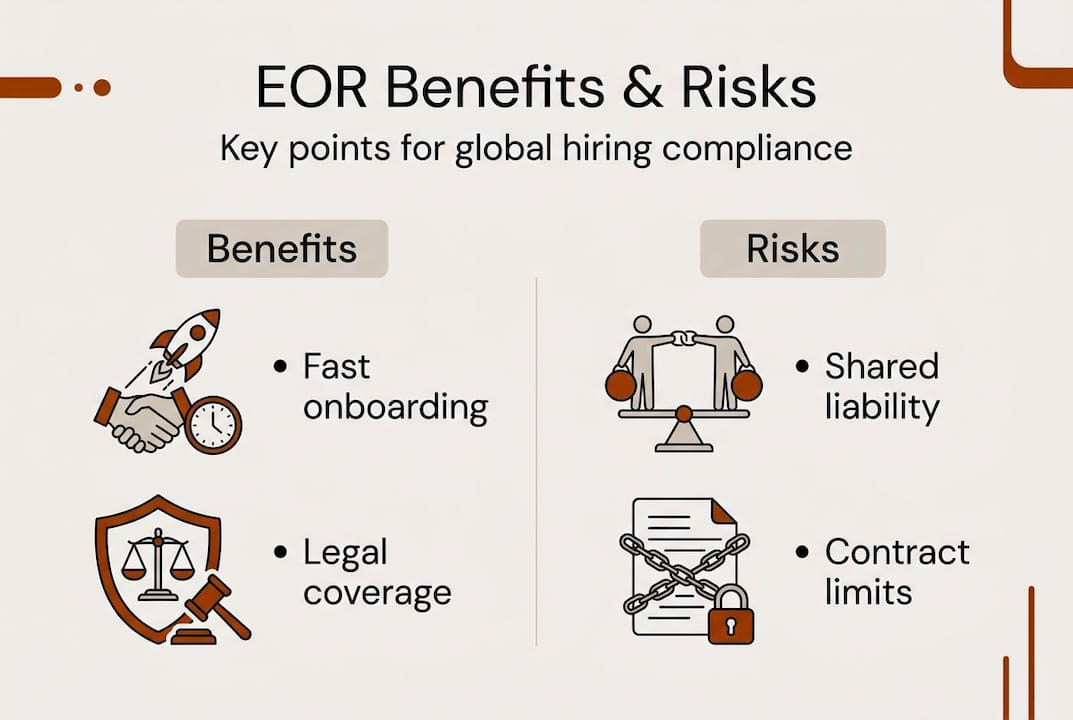
EOR services simplify hiring and compliance, letting companies scale faster in new markets. This outcome is not theoretical; it reflects the operational reality for companies that have eliminated the need for multi-country entity setup in their expansion programs.
The primary business benefits include:
- Accelerated onboarding. International employees can be legally employed and operationally active within days of contract execution, compared to the months required for entity incorporation.
- Reduced administrative overhead. Payroll, tax filings, social security administration, and statutory reporting are centralized under the EOR, freeing HR teams to focus on talent management rather than compliance mechanics.
- Access to global talent pools. EOR removes the geographic constraint on hiring decisions. Companies can recruit the best available candidate regardless of location without establishing a new legal presence.
- Agility in M&A and project-based expansion. When companies acquire teams in new jurisdictions or launch project-specific operations, EOR provides a compliant employment structure that can be stood up and wound down with minimal friction.
- Scalability without proportional cost increases. Adding headcount in an EOR-covered jurisdiction does not require proportional increases in legal or administrative infrastructure.
Consider a practical scenario: a mid-sized logistics company based in Romania needs to hire engineers in Germany and customer service staff in the Netherlands for a 24-month project. Rather than incorporating subsidiaries in two countries, the company engages an EOR service with direct entities in both markets. Employees are onboarded within two weeks, fully compliant with local labor law, and the company avoids the ongoing cost of maintaining two foreign legal entities after the project concludes.
This model is particularly relevant for industries facing acute labor shortages, including construction, logistics, manufacturing, and hospitality, where speed of deployment is a competitive differentiator.
Why EOR isn’t a cure-all: Our hard-earned lessons
Having examined the operational benefits, it is worth offering a candid assessment of what EOR arrangements cannot resolve and where HR teams most frequently encounter problems.
The most persistent misconception is that engaging an EOR transfers all employment responsibility to the provider. It does not. EOR shifts, not eliminates, employment risk: oversight, control, and compliance remain in the client’s court. Companies that treat EOR as a set-and-forget solution routinely discover compliance gaps during audits, often related to employment direction practices that were never reviewed against local law.
Contracts and reporting structures require active management. A well-drafted employment contract becomes a liability if the client’s actual management practices deviate from its terms. Regular reviews, documented instruction protocols, and periodic audits are not optional enhancements; they are structural requirements for a compliant EOR program. The EOR service realities are straightforward: the provider handles the legal employment infrastructure, but the client remains accountable for how it exercises authority over the workforce.
Connect with EOR and global mobility experts
If your organization is evaluating EOR services or seeking to optimize an existing international workforce program, Nestlers Group offers end-to-end solutions built on direct entity ownership across key European markets. From structuring compliant employment arrangements to managing payroll, tax, and relocation logistics, the Nestlers team operates as a full-stack workforce mobility partner. Explore EU mobility programs to understand the regulatory landscape, review how consulting for workforce mobility can support your HR strategy, or access the full range of global mobility solutions to identify the right service configuration for your expansion objectives.
Frequently asked questions
Does an employer of record service fully eliminate hiring risk?
No. Client remains responsible for employment direction even with EOR in place, meaning that how a company manages and instructs its workers still carries direct legal exposure.
How does EOR work for hiring employees in Germany?
In Germany, EOR providers must hold a valid AÜG license and comply with labor leasing regulations. Germany’s AÜG revised guidelines support compliant EOR use, but provider selection and contract structure require careful attention to statutory requirements.
What are the key criteria for selecting an EOR provider?
Direct entity ownership in each hiring country is the primary criterion. Owned-entity EORs are preferred over partner networks to eliminate subcontracting risk, alongside a verified compliance record and transparent reporting capabilities.
Can EOR solutions help scale a multinational workforce quickly?
Yes. EOR simplifies hiring and compliance, enabling companies to onboard international employees in days rather than months, without requiring the establishment of local legal entities in each target market.
Recommended
- Employer of Record (EOR) in Romania: Hire Employees Without a Local Entity (2026 Guide) – Nestlers Group
- Employer of Record Romania: The Smartest Way to Hire and Stay Fully Compliant – Nestlers Group
- Hire Remote Employees in Romania – Nestlers Group
- Romania’s Immigration & Mobility Partner – Nestlers Group
Connect with Nestlers consultants
Do you need immigration and relocation services or consultancy?
It’s easy! Use the below contact form and one of our experts will provide you an answer as soon as possible.
Our consultants can help you in obtaining legal documents and can provide you with assistance regarding the immigration processes, relocation, taxes and payroll, Social Security (European forms A1, S1, U1, etc.) for your employees.