
Workforce mobility is frequently categorized as an administrative HR function, but this classification significantly understates the legal, tax, and operational complexity that multinational companies face when deploying or receiving talent across EU borders. In Romania specifically, EU immigration regulations intersect with national labor law, social security frameworks, and posted worker directives to create a multi-layered compliance environment that demands deliberate, expert-led management. Organizations that treat mobility as a simple paperwork exercise routinely encounter penalties, delayed deployments, and talent disruption. This guide explains what mobility management actually covers, why it matters for HR and compliance leaders in 2026, and how a structured approach reduces risk while improving operational outcomes.
Key Takeaways
| Point | Details |
|---|---|
| Legal compliance is crucial | Mobility management ensures you meet EU and Romanian law, avoiding major penalties. |
| Efficiency gains | Professional mobility solutions streamline even the most complex HR and compliance workflows. |
| Integrated approach reduces risk | Centralizing permits, notifications, and legal reviews cuts errors and protects your business. |
| Expert help is essential | Relying on specialists gives you confidence and clarity in ever-changing European regulations. |
What is mobility management (and why does it matter)?
Mobility management is the structured governance of all legal, regulatory, tax, and logistical processes involved in moving employees across national borders for work purposes. It is not limited to filing visa applications or updating HR records. At its full scope, mobility management integrates legal reviews, work permit processing, immigration compliance, tax registration, social security coordination, and employee integration into a single, traceable workflow.
For companies operating in or through Romania, the scope extends further. Romanian immigration law distinguishes between EU nationals, who require registration rather than permits, and non-EU nationals, who must obtain work authorizations before entering employment. Alongside national rules, EU-level directives on posted workers, the single permit, and the intra-corporate transferee permit create additional compliance layers that must be addressed in parallel.
Understanding the mobility program basics is the first step toward building a governance model that actually holds under regulatory scrutiny. The core elements of a well-designed mobility management program include:
- Work permit and visa management: Identifying the correct authorization category, preparing documentation, and tracking expiry dates to prevent lapses.
- Immigration and residence compliance: Registering employees with local authorities within legally prescribed timeframes.
- Tax and social security registration: Ensuring employees and employers fulfill obligations in both the home and host country.
- Legal review of assignment terms: Verifying that employment contracts, remuneration structures, and assignment letters meet host-country requirements.
- Employee integration support: Providing housing, banking, healthcare registration, and cultural orientation services that reduce attrition.
The range of employee relocation types further shapes which compliance pathways apply. Short-term business travel, posted worker deployments, long-term assignments, and permanent transfers each carry distinct legal obligations, and conflating them is one of the most common sources of non-compliance in multinational operations.
Mobility management is not a cost center. It is a risk management function that protects market access, employer reputation, and employee welfare across every jurisdiction of operation.
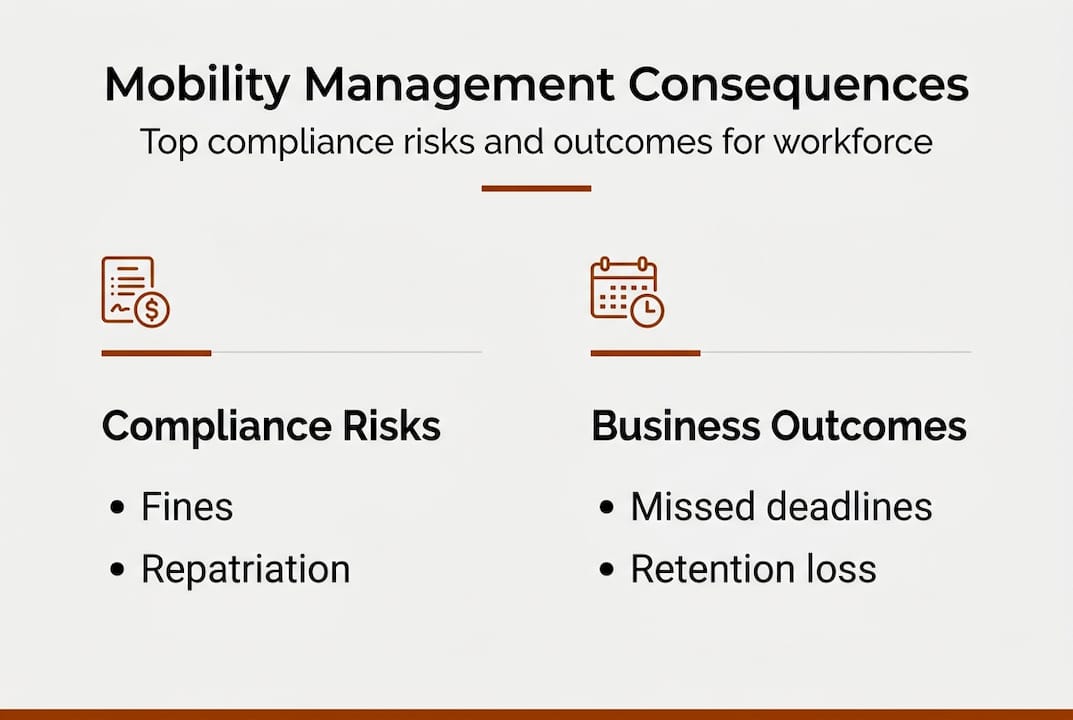
Companies that neglect this framework face concrete consequences: administrative fines, forced repatriation of workers, loss of EU posting privileges, and reputational damage in host-country labor markets. In Romania, enforcement activity by labor inspectorates and immigration authorities has intensified in recent years, making proactive compliance management a business-critical priority.
Key reasons to choose mobility management for HR compliance
Building on the definition above, the case for adopting robust mobility management rests on several specific compliance and operational drivers that directly affect multinational HR and legal teams.
- Regulatory alignment across jurisdictions: EU mobility law is not static. Posted worker amendments, updated single permit procedures, and national transposition measures change annually. A structured mobility management framework ensures that legal updates are tracked and incorporated into operational workflows before they trigger liability.
- Integrated permit and visa processing: Managing work authorizations in isolation from tax and social security registrations is a structural inefficiency. Professional mobility services manage notifications, legal reviews, and compliance documentation as a coordinated package, reducing the risk that one delayed step blocks an entire assignment.
- Posted worker compliance: For companies deploying Romanian workers into other EU member states, the A1 certificate, host-country notifications, and applicable remuneration rules must all be in place before the posting begins. Working with an experienced Romania mobility partner significantly reduces the administrative burden on internal HR teams.
- Tax and social security accuracy: Dual taxation exposure, incorrect social security base calculations, and missed registration deadlines are among the most financially consequential mobility errors. Coordinated mobility management addresses these proactively rather than reactively.
- Reduced administrative overhead: HR teams operating without structured mobility support spend disproportionate time on procedural tasks rather than strategic talent management. Centralizing compliance functions reduces errors and frees capacity.
Pro Tip: Before launching any cross-border assignment, conduct a formal pre-assignment compliance review covering work authorization category, applicable tax treaties, social security agreement status, and host-country notification obligations. Identifying gaps at this stage is far less costly than remediation after deployment. Reviewing common HR mobility challenges before designing your program can surface specific risk areas relevant to your industry and assignment profile.
Research consistently shows that companies using structured mobility management programs report materially lower rates of compliance incidents and assignment failures compared to those relying on ad hoc HR-driven processes. The efficiency gains compound over time as standardized workflows replace repeated improvisation.
How mobility management streamlines global workforce movement
With the compliance rationale established, it is equally important to examine the operational value that professional mobility management delivers, particularly for companies managing both inbound workforce into Romania and outbound deployments across the EU.
Centralized mobility management facilitates seamless movement and deployment for a global workforce by consolidating legal, tax, visa, and logistical workflows under a single governance structure. The practical effects are measurable:
- Faster onboarding timelines, because permit applications and tax registrations are initiated in parallel rather than sequentially.
- Fewer assignment delays caused by missing documents or overlooked notifications.
- Clearer employee experience, as assignees receive coordinated support rather than fragmented instructions from multiple internal teams.
- Reduced error rates in payroll and social security reporting, because the underlying compliance data is managed centrally.
The contrast between HR-driven and professionally managed mobility processes is significant. The table below illustrates the key differences:
| Factor | HR-driven process | Professional mobility management |
|---|---|---|
| Work permit tracking | Manual, prone to lapses | Automated with expiry alerts |
| Tax registration | Often delayed or missed | Initiated at assignment start |
| Posted worker notifications | Inconsistent | Structured and fully documented |
| Employee support | Limited to paperwork | End-to-end integration support |
| Compliance audit readiness | Low | High, with documented trail |
Exploring streamlined mobility solutions designed for the EU environment shows how these operational gains translate into measurable cost and risk reduction for companies of varying sizes. For organizations specifically managing posting worker steps into other EU states, the benefits of a structured approach are particularly pronounced, given the multi-country notification and remuneration verification requirements involved.
Employee retention is also affected. Assignees who experience friction during onboarding, particularly around housing, banking, and local registration, disengage faster and are more likely to request early repatriation. Professional mobility management addresses these integration elements directly, protecting the employer’s investment in international talent.

Mobility management in action: Romania and EU best practices
Understanding the benefits is useful, but seeing mobility management applied to a concrete scenario clarifies what effective practice actually requires. Consider a company relocating a non-EU national into Romania for a 24-month assignment.
Step-by-step process for an inbound assignment to Romania:
- Pre-assignment legal review: Determine the applicable work authorization category, check for any bilateral agreements between Romania and the employee’s home country, and verify whether the role qualifies under a specific permit scheme.
- Work permit application: Prepare and submit the authorization request to the Romanian General Inspectorate for Immigration, including the employment contract, proof of qualification, and employer documentation.
- Visa processing: Once the work permit is approved, support the employee in obtaining the long-stay visa from the Romanian consulate in their country of residence.
- Residence permit registration: Within the legally prescribed period after arrival, register the employee and submit the residence permit application.
- Tax and social security registration: Register the employee with Romanian tax authorities, determine applicable social security contributions, and assess whether a tax treaty applies to the employee’s situation.
- Settling-in support: Coordinate housing, open a local bank account, register with a general practitioner, and complete school registration for accompanying family members if applicable.
Effective mobility management in Romania and across the EU requires careful coordination of work permits, visas, and legal reviews as parallel rather than sequential tasks. The Romania relocation compliance guide provides detailed guidance on documentation requirements and processing timelines relevant to 2026 regulations.
For assignments involving variable or split remuneration structures, understanding how to calculate salary for mobility correctly is essential for both payroll accuracy and social security base calculations. Additionally, companies bringing non-EU nationals into Romania should monitor updates related to the new EU single permit rules, which affect processing timelines and eligibility criteria.
| Assignment phase | Key documents | Responsible party |
|---|---|---|
| Pre-assignment | Legal review, contract draft | Employer + mobility advisor |
| Permit application | Authorization form, employer docs | Mobility provider |
| Entry and registration | Visa, residence application | Employee + mobility provider |
| Ongoing compliance | Tax filings, permit renewals | Employer + payroll team |
Pro Tip: Always verify the current version of both EU directives and Romanian national implementing legislation before initiating a new assignment. National transposition measures frequently introduce requirements that exceed the minimum standards set by the EU directive, a practice known as gold plating, and these additional obligations are often overlooked by HR teams relying on outdated guidance.
Why most companies underestimate mobility management (and what they miss)
Despite the evidence for structured approaches, a substantial number of multinational HR teams still manage cross-border assignments through fragmented, ad hoc processes. Work permits are handled by one team, tax registrations by another, and employee support is either outsourced to the assignee or ignored entirely. This fragmentation is not simply inefficient; it creates overlapping risk exposures that compound over time.
The organizations that consistently achieve successful mobility outcomes treat compliance governance as a strategic function rather than a transactional one. They invest in unified workflows, specialist expertise, and real-time regulatory monitoring. The result is not just fewer compliance incidents but measurable improvements in talent retention, assignment completion rates, and cost predictability.
What most companies miss when reviewing mobility challenges insights is that the true cost of poor mobility management is not the fine or the delayed permit. It is the lost assignment, the disengaged employee, and the market access that was never fully realized. Companies that integrate mobility management as a core operational competency are building a structural advantage that becomes more valuable as workforce internationalization increases.
Get expert mobility management for your workforce
For HR and compliance leaders managing international workforce movement in or through Romania, Nestlers Group provides end-to-end mobility program solutions covering immigration, tax, payroll, and employee integration. With over a decade of operational experience in Romanian and EU mobility law, Nestlers supports both inbound talent acquisition and outbound workforce deployment across Europe. Whether your organization is managing short-term postings, long-term assignments, or permanent relocations, the full range of international relocation services is structured to address your specific compliance obligations. To discuss your organization’s mobility requirements and receive tailored guidance, contact our mobility experts directly.
Frequently asked questions
What are the main compliance risks in EU mobility management?
The primary risks are missed legal notifications, incorrect or lapsed work permits, and inaccurate tax and social security handling, all of which can result in heavy fines or blocked operations in Romania and other EU member states.
How does mobility management improve HR operations?
It consolidates visa, tax, and documentation workflows into a coordinated process, reducing errors and ensuring that compliance steps are automated rather than dependent on individual HR staff tracking each obligation manually.
Can small companies benefit from mobility management services?
Yes. Even smaller or early-stage companies benefit from reduced compliance risk and lower administrative overhead, as expert-led mobility management addresses legal requirements proportionally regardless of company size.
What laws affect mobility management in Romania?
The applicable legal framework includes EU-level directives on work and residence permits, the Posted Workers Directive, and Romanian national implementing legislation, all of which dictate required permits and procedural notifications for both inbound and outbound workforce movement.
Recommended
- Understanding mobility programs: legal workforce relocation in the EU
- Top HR challenges in global mobility for multinationals
- Types of employee relocation: solutions for HR and compliance
- How consulting transforms workforce mobility for EU corporations
- Employment law in security: 2026 compliance guide for UK firms|SJB
Connect with Nestlers consultants
Do you need immigration and relocation services or consultancy?
It’s easy! Use the below contact form and one of our experts will provide you an answer as soon as possible.
Our consultants can help you in obtaining legal documents and can provide you with assistance regarding the immigration processes, relocation, taxes and payroll, Social Security (European forms A1, S1, U1, etc.) for your employees.