
When a Romanian engineering firm deploys ten specialists to Germany without first securing A1 certificates, the consequence is not merely administrative inconvenience. The employees may face double social security contributions in both Romania and Germany, the employer may receive penalty notices from both jurisdictions, and benefit entitlements accumulated at home can be disrupted entirely. EU social security coordination is governed by Regulation (EC) No 883/2004 and implementing Regulation (EC) No 987/2009, establishing that no worker should contribute twice or lose coverage across Member States, but these protections only materialize when HR teams execute the underlying workflow correctly and on time.
Key Takeaways
| Point | Details |
|---|---|
| Prevent double contributions | EU social security coordination ensures employees do not pay contributions in multiple countries by following proper workflows. |
| Apply early for A1 | Start the A1 certificate process well ahead of assignments to avoid delays and compliance risks. |
| Telework requires special handling | Remote or cross-border telework may require unique social security assessments, with no safe thresholds for duration. |
| Document everything | Keep all certificates and supporting documents ready for audits, as inspections are increasing across Europe. |
| Expert guidance minimizes risks | Relying on experienced partners can avoid workflow mistakes and ensure multinational compliance. |
What is the employee social security workflow for EU assignments?
The employee social security workflow refers to the structured set of procedural steps, documentation requirements, and inter-authority communications that multinational employers must complete to establish, maintain, and verify compliant social security coverage for internationally assigned employees. Within the EU, this workflow is not discretionary. It is legally mandated and precisely sequenced.
The regulatory foundation rests on two instruments. Regulation (EC) No 883/2004 establishes the principle of single-state coverage, meaning an employee working across borders may only be subject to the legislation of one Member State at any given time. Regulation (EC) No 987/2009 specifies the procedural mechanisms, forms, and timelines through which that determination is made and certified.
For HR managers at multinationals, understanding the scope of the workflow is the first prerequisite to executing it correctly. The following table summarizes the core elements that any compliant social security workflow must address for EU assignments.
| Workflow element | Purpose | Required form | Governing body | Typical timeline |
|---|---|---|---|---|
| Determining applicable legislation | Confirming which Member State has jurisdiction | PD A1 (Portable Document A1) | Home country authority | 4 to 12 weeks depending on country |
| Notification of posting | Alerting host country to assignment | Host-country notification form | Host country authority | Before or on assignment start |
| Social security registration | Registering employee if legislation shifts | Country-specific form | Host country social security authority | Varies by jurisdiction |
| Certificate retention | Compliance documentation | A1 certificate | Employer | Duration of assignment plus audit period |
| Certificate renewal | Extending coverage for long assignments | New A1 application | Home country authority | Before expiry of current certificate |
The workflow affects a specific and well-defined set of employee categories. HR teams should recognize that the obligations extend beyond what many organizations assume:
- Posted workers sent temporarily by their employer to perform work in another Member State
- Remote employees working from a Member State other than where their employer is established
- Short-term business travelers attending meetings, training, or client events across EU borders
- Multi-state workers habitually working in two or more Member States simultaneously
- Locally hired expatriates employed directly in a host country but potentially retaining home-state coverage in transitional periods
- Secondees temporarily placed with a group entity in another Member State under an intra-company arrangement
HR professionals seeking a foundational overview may also benefit from reviewing social security coordination for expatriates, which addresses the broader compliance picture relevant to individual mobile employees.
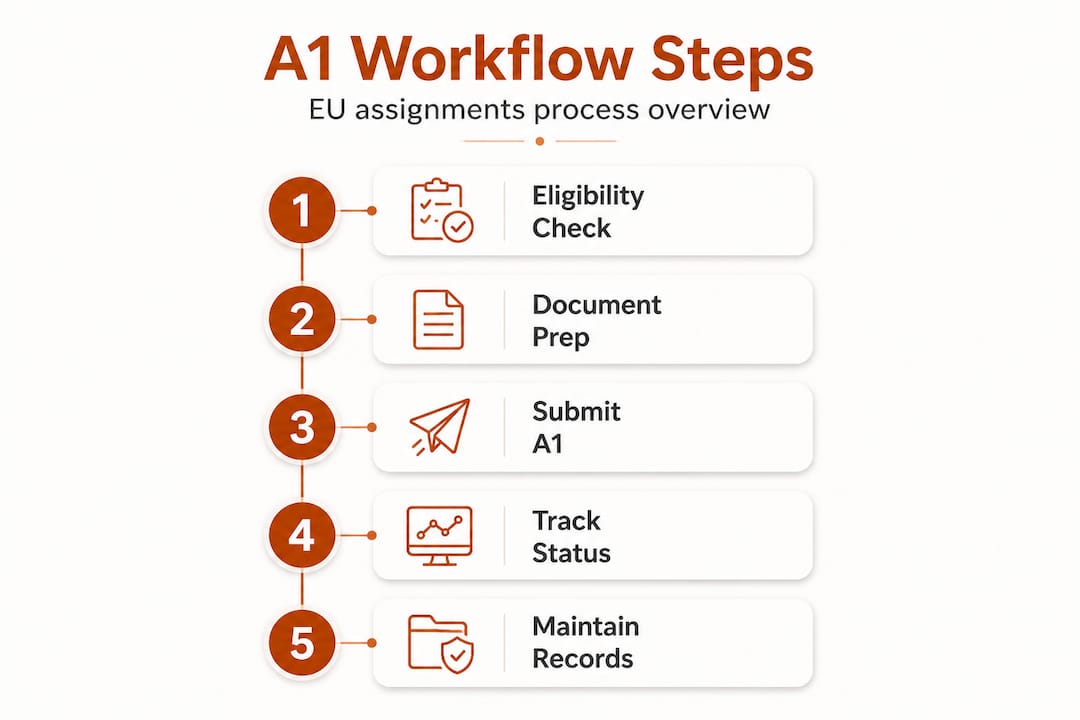
Step-by-step social security workflow for international assignments
Once the scope is understood, the practical execution of the workflow requires methodical sequencing. Missing a single step, or completing steps out of order, can invalidate the certificate and expose the employer to retroactive contribution demands in the host country.
The following numbered process reflects best practice for a standard posted worker assignment within the EU.
-
Determine the applicable legislation. Before any paperwork is initiated, the HR team must assess which Member State’s legislation governs the employee. For posted workers, this is generally the home state, provided the employer habitually carries out substantial activities there, and the posting does not exceed 24 months.
-
Confirm employee eligibility for posting status. The employee must have been subject to home-state legislation immediately before the posting begins. A new hire placed directly in the host country without prior home-state coverage does not qualify as a posted worker under Regulation 883/2004.
-
Prepare and submit the A1 application. The employer applies to the home country’s social security authority before assignment starts, and the process varies by country. For example, SVB (Sociale Verzekeringsbank) handles applications in the Netherlands, URSSAF administers the process in France, and the ZUS (Zakład Ubezpieczeń Społecznych) is the relevant body in Poland. Romania’s counterpart is Casa Naționala de Pensii Publice (CNPP), which processes A1 applications for Romanian posted workers.
-
Complete host-country notification requirements. Many EU Member States require advance notification of incoming posted workers, separate from the A1 process. Germany, France, Belgium, Austria, and the Netherlands all maintain mandatory declaration systems with their own digital portals and filing deadlines.
-
Receive and distribute the A1 certificate. Once issued, the A1 must be retained by the employer and carried by the employee. The employee must be able to produce it on inspection by host-country authorities.
-
Monitor the assignment duration and plan renewal. If the assignment will exceed 24 months, an extension agreement under Article 16 of Regulation 883/2004 may be possible, but this requires joint application by both the employer and employee to the competent authorities of both states.
-
Close the assignment and update records. When the assignment ends, the employer must update payroll records, terminate any temporary host-country registrations, and ensure that home-state contributions resume without interruption.
The table below compares the A1 process across several jurisdictions commonly involved in assignments from or through Romania.
| Country | Competent authority | Processing time | Filing method | Notes |
|---|---|---|---|---|
| Netherlands | SVB | 4 to 8 weeks | Online portal | Retroactive issuance possible but not guaranteed |
| France | URSSAF | 6 to 12 weeks | Online via net-entreprises.fr | Delays common during peak posting periods |
| Germany | Deutsche Rentenversicherung | 6 to 10 weeks | Electronic data exchange (ELAN-K2) | Host notification via MiLoG system also required |
| Belgium | INSS (ONSS) | 4 to 8 weeks | Online via LIMOSA | LIMOSA notification mandatory before assignment start |
| Romania | CNPP | 4 to 6 weeks | Written or electronic application | Required for outbound posted workers |
For operational HR teams, cross-border social security registration guidance provides a more granular breakdown of country-specific requirements. Additionally, the broader compliance picture for employers sending staff abroad is addressed in resources on managing posted workers in Europe.
Pro Tip: Start the A1 application process at least 8 weeks before the assignment begins. In high-volume jurisdictions such as France or Germany, processing delays are routine. A certificate that arrives after the assignment starts provides limited protection during that gap, and some host-country authorities may disregard retroactive issuance.
Telework, edge cases, and troubleshooting common mistakes
Standard posting scenarios are comparatively straightforward. The more complex compliance challenges arise from atypical assignment structures, and experienced HR teams know these edge cases generate the majority of enforcement risk.
Note: There is no minimum assignment duration that exempts an employer from social security compliance obligations. A single-day cross-border business trip to perform substantive work may require an A1 certificate, and no “safe days” threshold exists under EU coordination rules.
The rise of hybrid and remote work has added significant complexity to social security determination. Remote and cross-border telework requires an A1 assessment, and a Framework Agreement mechanism allows home-country coverage for employees who telework between 25 and 50 percent of their working time, provided both the home and host states are signatories. As of 2026, the Framework Agreement on cross-border telework has been signed by most EU Member States, but coverage is not universal and conditions apply strictly.
The following mistakes are consistently observed in organizations that lack a formalized workflow process:
- Waiting until the assignment begins to initiate A1 applications, resulting in a compliance gap during the processing period
- Assuming short assignments are exempt, when even multi-day technical visits or on-site consultations can trigger host-country obligations
- Misclassifying remote employees as posted workers, when the regulatory tests for these two categories differ substantially and lead to different legislative outcomes
- Failing to track multi-state workers separately, as employees who regularly work in two or more countries are subject to a different determination process under Article 13 of Regulation 883/2004, not the posting rules of Article 12
- Treating the A1 as a one-time task rather than a continuously managed compliance instrument, leading to expired certificates and lapses in documented coverage
- Ignoring host-country notification systems, which are legally distinct from the A1 process and carry their own penalties for non-compliance
- Failing to update records when assignment terms change, such as when a 6-month assignment is extended to 18 months, or when an employee’s work location shifts to a third Member State
HR teams that consult HR’s guide to social security coordination early in their workflow design phase are better positioned to anticipate these variables and build appropriate process controls.
Pro Tip: Always secure the A1 certificate before any cross-border work begins, including short technical visits, product training in the host country, or participation in cross-border project kick-offs. The investment of time in advance filing is considerably smaller than the cost of rectifying a compliance breach identified during a host-country inspection.
Verifying compliance and preparing for audits
The final stage of a well-managed social security workflow is not the issuance of the A1 certificate. It is the systematic maintenance of documentation that can withstand regulatory scrutiny. Enforcement by national authorities and cross-border inspections has intensified markedly, and the operational readiness of HR teams is now a material compliance variable.
The following documents must be retained for each internationally assigned employee and made available promptly upon request by inspecting authorities:
- A1 certificate (current and all historical certificates for the employee)
- Employment contract reflecting the terms of the assignment, including home-state employer details
- Assignment letter or secondment agreement specifying host-country location, duration, and scope of work
- Proof of home-state residence for the employee, confirming the employee’s center of life during the assignment
- Evidence of substantial activity in the home state by the employer, which supports the legitimacy of posting status
- Host-country notification confirmations, such as LIMOSA receipts, MiLoG registration acknowledgments, or equivalent
- Payroll records showing that contributions are being paid in the correct jurisdiction throughout the assignment
- Renewal correspondence for assignments extended beyond the initial certificate period
Verification of A1 validity has become more rigorous. Several Member States have implemented or are implementing digital verification registries, and host-country labor inspectorates increasingly cross-reference on-site employee documentation against their national systems. An A1 certificate that exists on paper but has not been filed correctly with the issuing authority, or that covers a different assignment period than the actual deployment, will not satisfy inspectors.

EU enforcement trends show a clear trajectory toward stricter process enforcement, with the European Labour Authority (ELA) coordinating joint inspections across Member States. The ELA, established to support the fair enforcement of EU labor and social security law, has progressively increased its joint inspection activity, and the number of coordinated operations involving multiple Member States has grown since the authority reached operational maturity. HR teams should treat the possibility of a joint ELA-coordinated inspection as an operational reality rather than a remote scenario.
Compliance readiness also requires reviewing your legal obligations for cross-border assignments periodically, not only at the point of assignment initiation, because regulatory requirements in individual Member States continue to evolve through national implementing legislation.
A reality check: What most HR teams miss about EU social security workflows
Having reviewed hundreds of assignment processes across industries and jurisdictions, a consistent pattern emerges: most compliance failures are not the result of ignorance of the regulations. They are the result of organizational assumptions that remain unchallenged long after the underlying circumstances have changed.
The most pervasive of these assumptions is that a workflow which functioned correctly for one assignment type will transfer unchanged to another. A process built for short-term technical postings to Germany will not reliably cover a hybrid remote worker splitting time between Romania and the Netherlands. The regulatory tests are different, the competent authorities are different, and the documentation requirements diverge in meaningful ways. Yet HR teams, under operational pressure, frequently apply the familiar process rather than re-evaluate the specific facts.
“What works on paper often fails in practice when assignments involve multiple countries, overlapping timelines, and employees whose actual work patterns do not match the original assignment letter.”
A second critical gap is the absence of centralized workflow ownership. When social security compliance is delegated entirely to country-level HR managers or local payroll teams, coordination across borders fractures. The home-country team may issue an A1 without knowing the employee has already started work in the host country. The host-country team may complete a local registration that conflicts with the A1 determination. Neither team has the full picture, and the resulting compliance gaps only surface during an audit.
The practical resolution is structural. Organizations with consistent cross-border compliance records tend to designate a central mobility compliance function, or a qualified external partner, with explicit responsibility for coordinating the workflow across all jurisdictions involved in an assignment. This function holds the full record, monitors certificate validity, tracks notification obligations, and escalates edge cases before they become enforcement matters.
Reviewing multinational posting challenges as part of regular HR training reinforces awareness of these structural risks and helps mobility teams build the institutional knowledge necessary to manage complex assignment portfolios.
Pro Tip: Designate a workflow owner with cross-country oversight responsibility for every assignment involving more than one jurisdiction. Never rely solely on country managers to self-coordinate, as structural gaps in communication between home and host teams are the single most common source of preventable compliance failures.
Simplify your global social security workflow with expert support
Managing the EU social security workflow for international assignments requires precise execution across multiple jurisdictions, each with its own procedural requirements, filing deadlines, and enforcement expectations. For HR and compliance teams already managing complex workforce deployments, the administrative burden is substantial and the margin for error is narrow.
Nestlers Group provides end-to-end support for organizations navigating this landscape. From A1 certificate management and host-country notification compliance to payroll coordination and audit preparation, the services are designed to integrate directly into your existing assignment process. Explore global mobility solutions to understand the full scope of available support. For teams developing or reviewing their mobility framework, guidance on mobility programs in the EU provides a structured starting point. Organizations seeking specific support for individual employee relocations can also review employee relocation solutions tailored to HR compliance requirements. Contact Nestlers Group directly to discuss a workflow structure suited to your organization’s assignment profile and risk posture.
Frequently asked questions
Do I need an A1 certificate for a one-day business trip within the EU?
Yes. There is no safe days threshold under EU social security coordination rules, meaning even a single-day business trip involving substantive work in another Member State may require an A1 certificate.
Who processes the A1 certificate and how long does it take?
The home country’s social security authority processes the A1 certificate before the assignment begins, and the timeline varies by country, typically ranging from 4 to 12 weeks depending on the issuing authority.
Does remote work from another EU country affect social security coverage?
Yes. Cross-border telework requires an A1 assessment and, where the employee teleworks between 25 and 50 percent of the time, coverage may remain in the home state under the Framework Agreement if both states are signatories.
What documents are essential for a compliance audit?
The A1 certificate, employment contract, assignment letter, proof of residence, and host-country notification confirmations are all essential, as ELA joint inspections increasingly cross-reference physical documentation against digital records held by national authorities.
Recommended
Connect with Nestlers consultants
Do you need immigration and relocation services or consultancy?
It’s easy! Use the below contact form and one of our experts will provide you an answer as soon as possible.
Our consultants can help you in obtaining legal documents and can provide you with assistance regarding the immigration processes, relocation, taxes and payroll, Social Security (European forms A1, S1, U1, etc.) for your employees.