
When an employee on assignment in Germany receives a social security contribution demand from both German and Romanian authorities simultaneously, the instinct is to assume an administrative error. In practice, this scenario reflects a structural gap in how many HR and compliance teams manage cross-border assignments. Overlapping national social security obligations are not rare anomalies; they are a predictable consequence of inadequate coordination planning. This guide explains what social security coordination means under EU law, how its core principles apply to mobile employees, and what HR and compliance managers must understand to avoid costly regulatory exposure in 2026 and beyond.
Key Takeaways
| Point | Details |
|---|---|
| Single system coverage | EU rules ensure employees are covered by only one social security system at a time across borders. |
| Principles protect rights | Core principles like aggregation and exportability help maintain workers’ benefits and eligibility during mobility. |
| Telework has new rules | Remote work exceptions from 2023 mean HR must check new agreements to determine correct coverage. |
| Compliance avoids penalties | Proper social security coordination prevents costly administrative errors, double payments, and coverage gaps. |
What is social security coordination?
Social security coordination is a legal mechanism that determines which country’s social security legislation applies to a worker who is active across more than one EU member state. It is critical to distinguish coordination from harmonization. Harmonization would mean aligning national social security systems into a single uniform framework. Coordination, by contrast, leaves each member state’s system intact while establishing rules that prevent workers from falling through the gaps or being subject to duplicate obligations.
The legal foundation rests on two EU instruments. Regulation (EC) No 883/2004 and its Implementing Regulation (EC) No 987/2009 coordinate national social security systems without harmonizing them, specifically to facilitate free movement of workers across EU borders. These regulations apply to EU member states and, under separate arrangements, to EEA countries and Switzerland.
Social security coordination does not create a single European system. It creates a set of rules that connect existing national systems, ensuring that mobile workers are covered continuously and without duplication.
For HR professionals, the practical significance is substantial. An employee posted from Romania to the Netherlands, or a French national working partially in Belgium, is not simply subject to whichever country’s rules seem most convenient. The regulations determine applicable legislation through a structured set of criteria, and the employer bears legal responsibility for compliance with those determinations.
The EU coordination guide published by Nestlers Group provides further detail on how these regulations interact with national implementation. The framework covers sickness benefits, maternity and paternity benefits, invalidity benefits, old-age pensions, survivors’ benefits, benefits for accidents at work and occupational diseases, death grants, unemployment benefits, and family benefits. Coverage is broad, and the stakes for non-compliance are correspondingly high.
For multinational employers, understanding this framework is not optional. It is a prerequisite for structuring legally sound cross-border assignments, managing payroll contributions accurately, and protecting employees from coverage gaps that can materialize months or years after an assignment ends.
The four core principles of EU social security coordination
The coordination framework operates through four foundational principles, each of which carries direct implications for HR and payroll management. These four principles are equal treatment, aggregation, single applicable legislation, and exportability.
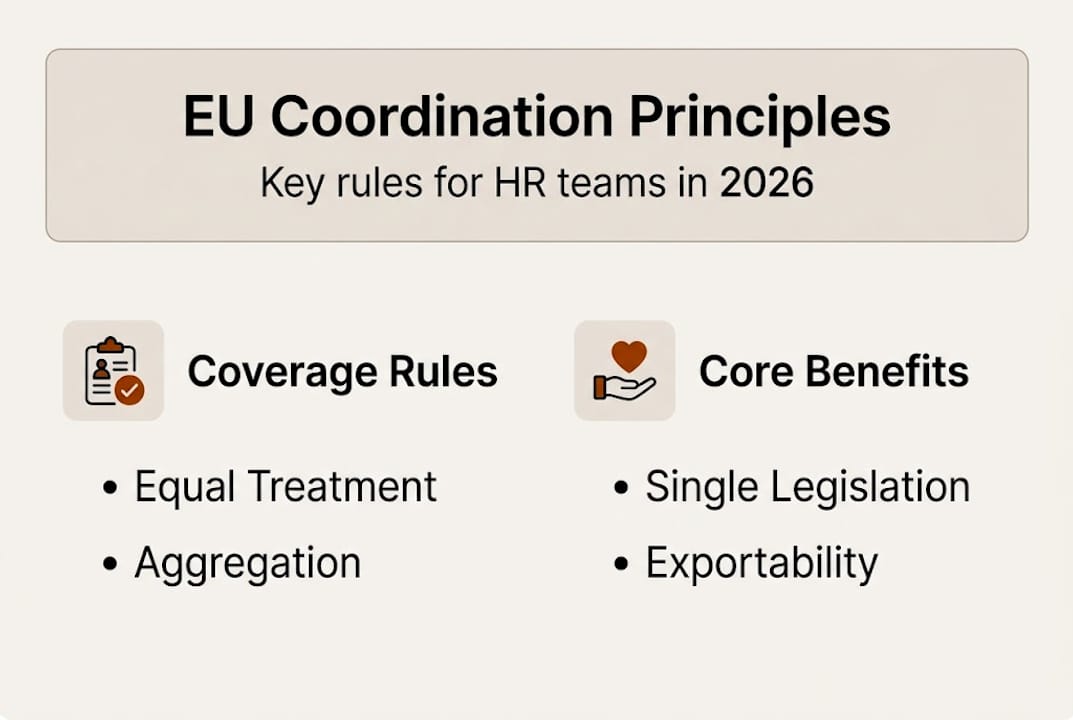
Equal treatment requires that mobile workers receive the same social security rights as nationals of the country whose legislation applies to them. An employee from Romania working in Austria cannot be denied access to Austrian social security benefits on the basis of nationality alone.
Aggregation allows periods of insurance, employment, or residence completed in different member states to be combined when calculating entitlement to benefits. This is particularly significant for pension eligibility. An employee who has worked seven years in Romania and eight years in Germany may qualify for a pension in both countries based on aggregated contribution periods, even if neither period alone meets the minimum threshold in either state.
Single applicable legislation is the most operationally critical principle. At any given time, a mobile worker is subject to the social security legislation of only one country. This eliminates the risk of double contributions in theory, though administrative failures can still produce that outcome in practice.
Exportability means that certain benefits, most notably pensions and some sickness benefits, can be paid to a beneficiary residing in a different member state from the one that awarded the benefit.
| Principle | Core meaning | HR/payroll implication |
|---|---|---|
| Equal treatment | Same rights as nationals | No differential treatment in benefit access |
| Aggregation | Combined contribution periods | Affects pension and unemployment eligibility |
| Single applicable legislation | One system at a time | Determines where contributions are paid |
| Exportability | Benefits payable across borders | Relevant for pension and long-term benefit planning |
Key operational considerations for HR teams include:
- Verifying which principle governs a specific benefit type before processing payroll
- Documenting aggregation periods for employees with multi-country careers
- Confirming cross-border registration obligations before an assignment begins
- Reviewing exportability eligibility for employees transitioning out of active assignments
Pro Tip: Many HR managers assume exportability applies automatically to all benefit types. It does not. Certain benefits, particularly unemployment benefits, have specific conditions and time limits on exportability that require advance verification.
Applicable legislation and recent telework exceptions
Determining which country’s social security system applies to a mobile worker requires applying a structured hierarchy of rules. The default rule is lex loci laboris, meaning that a worker is subject to social security in the country where work is physically performed. If an employee works in France, French social security law applies, regardless of where the employer is established.
However, several exceptions modify this default:
- Posted workers: Employees sent by their employer to work in another member state for a temporary period may remain subject to the sending country’s legislation, provided specific conditions are met and an A1 certificate is obtained.
- Multi-state workers: Employees who habitually work in two or more member states are subject to the legislation of their residence state, if they perform a substantial part of their activity there.
- Civil servants: Subject to the legislation of the member state to which the employing administration belongs.
- Mariners and aircraft crew: Subject to specific rules based on flag state or home base.
The most significant recent development is the Framework Agreement on cross-border telework, which has been in effect since July 2023. This opt-in agreement allows employees who telework from their country of residence to remain subject to their employer’s country social security system, provided that telework in the residence state does not reach or exceed 50% of total working time (the operative threshold being 49.99% or less), and provided that both the employer’s country and the employee’s residence country are signatories to the agreement.
| Scenario | Applicable rule | Key condition |
|---|---|---|
| Standard cross-border work | Lex loci laboris | Work performed in that country |
| Posted worker | Sending country | A1 certificate required |
| Cross-border telework under 50% | Framework Agreement | Both states must be signatories |
| Multi-state worker | Residence state | Substantial activity threshold applies |
For HR teams managing delegation and secondment obligations, the Framework Agreement introduces both an opportunity and a compliance requirement. It allows greater flexibility in structuring hybrid work arrangements, but it demands rigorous tracking of where work is actually performed.
Pro Tip: The Framework Agreement applies exclusively to employees, not self-employed individuals. Always confirm signatory status for both countries before advising employees that they can remain in the employer’s country scheme.
Practical HR risks, compliance challenges, and digital solutions
When the applicable legislation is incorrectly determined or inadequately documented, the consequences extend well beyond administrative inconvenience. Failure to comply with coordination rules risks double contributions, regulatory penalties, and gaps in employee benefit coverage, with no established benchmarks on how frequently violations occur across the EU.
Common HR errors in multi-state posting scenarios include:
- Failing to obtain an A1 certificate before an assignment begins
- Assuming that short-term assignments fall below any notification threshold
- Misclassifying a multi-state worker as a posted worker
- Neglecting to track telework percentages for employees under the Framework Agreement
- Applying the wrong contribution base due to currency or benefit-in-kind miscalculation
Even a small paperwork error, such as a missing A1 certificate or an incorrectly dated posting notification, can trigger months of coverage disputes between national authorities, leaving the employee in legal limbo and the employer exposed to retroactive contribution demands.
The Electronic Exchange of Social Security Information system, known as EESSI, represents the EU’s primary digital infrastructure for cross-border coordination. EESSI enables national social security institutions to exchange information electronically, replacing paper-based processes that were prone to delay and error. For HR and compliance teams, EESSI’s existence means that national authorities have faster access to cross-border employment data, which increases the likelihood that discrepancies will be identified and acted upon.

For companies managing complex expatriate coordination scenarios, digital tracking of assignment dates, telework percentages, and contribution records is no longer a best practice. It is a compliance requirement. Employers should also consult resources on work visa compliance to ensure that social security obligations are assessed alongside immigration status from the outset of any assignment.
Unresolved issues and new developments in social security coordination
Despite the coherence of the EU coordination framework, significant unresolved issues persist that HR and compliance teams must monitor actively.
National differences remain substantial. Contribution rates, benefit structures, administrative procedures, and eligibility thresholds vary considerably across member states. Coordination rules determine which system applies, but they do not equalize what workers receive or what employers pay. An employee moving from a low-contribution environment to a high-contribution one will face a material change in cost, regardless of coordination compliance.
Key ongoing challenges include:
- Post-Brexit coordination: The United Kingdom is no longer covered by EU coordination regulations. Coordination between the UK and EU member states now operates under the Trade and Cooperation Agreement (TCA), which provides a more limited framework and excludes certain benefit categories that were previously covered.
- Framework Agreement limitations: The 2023 telework agreement excludes self-employed individuals entirely. Employers with mixed workforces of employees and contractors must apply different rules to each category, increasing administrative complexity.
- Opt-in complexity: Because the Framework Agreement is opt-in, not all EU member states have signed. HR teams must verify signatory status for each country pair involved in a cross-border telework arrangement.
- Legislative evolution: The EU continues to assess whether the Framework Agreement should be expanded or made permanent, and whether self-employed individuals should eventually be included.
For HR leaders responsible for 2026 coordination oversight, the practical implication is that coordination compliance requires continuous monitoring, not a one-time assessment at the start of an assignment.
Beyond the basics: What most HR teams overlook about social security coordination
Many HR teams approach social security coordination as a documentation exercise: obtain the A1 certificate, file the required notifications, and consider the matter resolved. This approach underestimates the dynamic nature of coordination obligations. Assignment conditions change. Employees shift between hybrid and on-site work. Signatory status of countries evolves. Each of these changes can alter the applicable legislation and trigger new obligations.
Relying on static templates and annual checklists creates exposure precisely because coordination is not a static legal state. It is a continuously assessed relationship between the employee’s work pattern, the employer’s structure, and the regulatory frameworks of multiple states.
The organizations that manage coordination most effectively treat it as an ongoing operational function, not a pre-assignment formality. They invest in digital tracking tools, maintain regular contact with mobility advisors, and build internal processes that flag changes in employee work patterns before those changes produce compliance consequences.
For in-depth coordination guidance tailored to specific assignment structures, engaging a specialist partner early in the assignment lifecycle produces measurably better outcomes than reactive remediation.
Pro Tip: Establish quarterly check-ins with your mobility and legal advisors to review active assignments against current signatory lists, telework thresholds, and any legislative updates. Proactive review cycles prevent the accumulation of undetected exposure.
Your HR partner for seamless social security coordination
Navigating EU social security coordination requires more than regulatory knowledge. It requires operational infrastructure, country-specific expertise, and the capacity to respond when assignment conditions change. Nestlers Group provides end-to-end support for HR and compliance teams managing cross-border workforce mobility, from A1 certificate procurement and posting notifications to payroll compliance and multi-state registration.
For organizations deploying workers across Europe or managing inbound assignments into Romania, Nestlers offers structured mobility programs for legal relocation that integrate social security compliance from the outset. To explore tailored solutions for your workforce, visit our global mobility solutions page or contact our advisory team directly.
Frequently asked questions
What is the main goal of social security coordination in the EU?
The main goal is to ensure that mobile workers are covered by one social security system at a time and retain their accumulated rights when moving across EU borders, without duplication or gaps in coverage.
Can an employee be subject to two social security systems at once?
No. EU rules require that employees are subject to the legislation of only one country at any given time, which is the single applicable legislation principle.
How does remote work affect applicable social security rules?
The 2023 Framework Agreement allows many cross-border remote workers to remain in their employer’s country scheme, provided that telework in the residence country stays below 50% of total working time and both countries are signatories.
What risks do HR teams face if they get coordination wrong?
Miscalculated or undocumented coordination can result in double contributions, penalties, and gaps in employee benefit coverage, all of which may only become apparent long after the assignment has concluded.
Recommended
- EU social security coordination for expatriates: 2026 guide
- Social security registration guide for cross-border employees
- EU Social Security’s New A1 Rules: Impact on Posted Workers & Labor Compliance – Nestlers Group
- Essential immigration procedures for HR: EU corporate guide
- Maximising Employee Benefits: A Guide for Employers – Price & Accountants
Connect with Nestlers consultants
Do you need immigration and relocation services or consultancy?
It’s easy! Use the below contact form and one of our experts will provide you an answer as soon as possible.
Our consultants can help you in obtaining legal documents and can provide you with assistance regarding the immigration processes, relocation, taxes and payroll, Social Security (European forms A1, S1, U1, etc.) for your employees.