
Multinational companies posting employees across European borders face a compliance challenge that is frequently underestimated: determining which country’s social security system governs a given worker at any specific moment. When this determination is incorrect, companies risk double contributions, regulatory penalties, denied benefit claims, and retroactive liabilities that can run into significant sums. The consequences extend beyond finance, affecting the individual worker’s access to healthcare, pensions, and other protections. This guide provides HR managers and compliance officers with a structured framework to accurately assess, document, and maintain social security obligations for posted workers operating across EU member states.
Key Takeaways
| Point | Details |
|---|---|
| Know legal definitions | Understanding who qualifies as a posted worker is key for compliance. |
| Gather the right documents | Having all contracts and supporting materials ready prevents processing delays. |
| Apply for A1 timely | Timely A1 application secures continued home country coverage and avoids penalties. |
| Audit and document steps | Careful recordkeeping and regular audits reduce risks of disputes or inquiries. |
| Treat compliance as strategic | See social security compliance as a talent and business advantage, not just red tape. |
Understanding your obligations: Fundamentals and legal definitions
Before any assessment can begin, HR teams must command a precise understanding of the regulatory framework that governs cross-border social security in the European Union. The primary instrument is Regulation (EC) No. 883/2004, which coordinates social security systems across EU member states and establishes which country’s legislation applies to a given worker at any time.
A posted worker is an employee who is sent by their employer to carry out work in another EU member state on a temporary basis, while remaining employed by the sending company. This is distinct from a regular international transfer, where the employment relationship itself relocates to the host country. Accurate classification matters enormously: a misidentified transfer could expose both employer and employee to unexpected host country social security obligations.
The A1 certificate (formerly E-101) is the document that confirms a posted worker remains subject to the social security legislation of their home country during the posting period. According to EU legal definitions, posted workers remain covered by their home country’s social security for up to 24 months if an A1 certificate is obtained. Without this document, host country authorities may legitimately claim that local social security contributions are owed.

Understanding Article 12 versus Article 13 of Regulation 883/2004 is critical. The following table summarizes the key distinctions:
| Provision | Scenario | Coverage rule | Duration |
|---|---|---|---|
| Article 12 | Single posting by employer to one EU state | Home country legislation applies | Up to 24 months |
| Article 13 | Worker in two or more EU states simultaneously | Determined by substantial activity rules | Ongoing review |
| Regular transfer | Employment contract transferred to host country | Host country legislation applies | Indefinite |
Failure to apply the correct provision leads to misclassification, which can result in penalties, retroactive contribution demands, and gaps in the worker’s social security protection. Review our cross-border registration guide and the broader context of EU social security coordination for additional regulatory background.
Key risks associated with misclassification include:
- Dual contribution liability in both home and host countries
- Worker losing access to home country benefits mid-assignment
- Administrative sanctions from host country labor inspection authorities
- Reputational damage in regulated industries
Preparation: What you need before the assessment
Once the legal framework is clear, the practical preparation phase begins. Accurate assessment depends entirely on the quality and completeness of information gathered before the posting commences. Incomplete data at this stage is the single most common reason for delayed A1 applications and subsequent compliance gaps.
The following documents and data points must be compiled for each posted employee:
| Required item | Purpose |
|---|---|
| Employment contract (home country) | Confirms ongoing employment relationship |
| Assignment letter or posting agreement | Defines scope, duration, and host country |
| Prior social security history | Identifies existing coverage periods |
| Anticipated posting duration | Determines applicable provision (Art. 12 or 13) |
| Countries of activity | Establishes single or multi-state scenario |
| Evidence of employer’s substantial activity | Proves business genuinely operates in home country |
The concept of substantial activity is a legal requirement under Article 12. The employer must demonstrate that it carries out significant business operations in the home country beyond purely internal administration. Evidence typically includes financial accounts, a local workforce, registered premises, and records of business transactions in the home state.
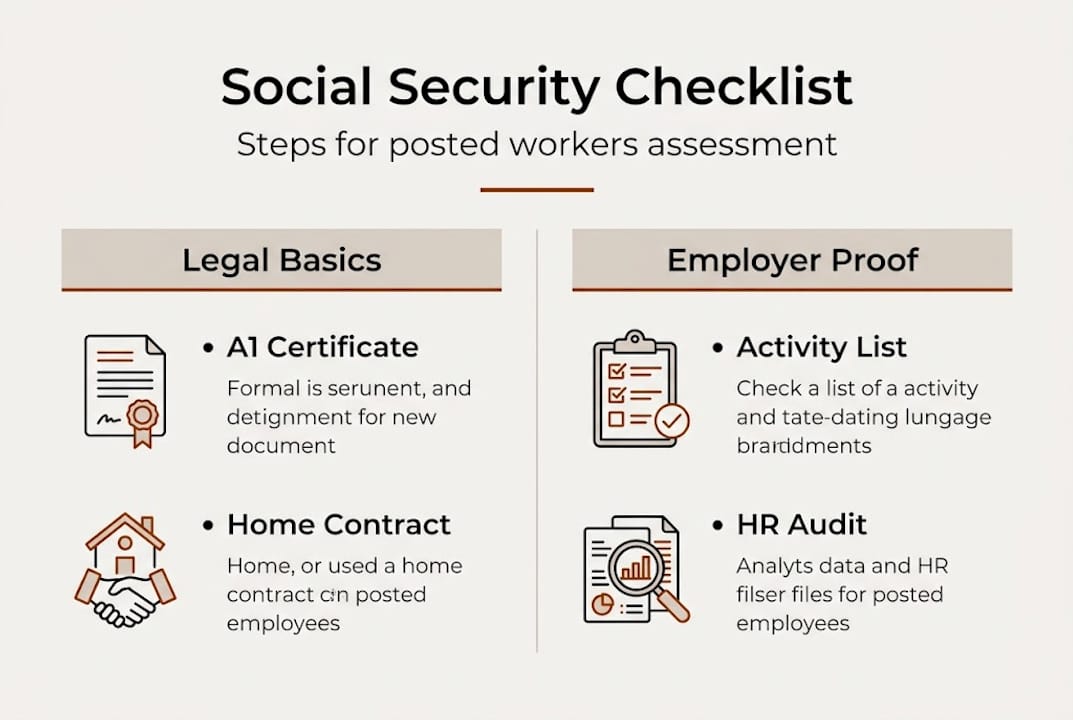
According to official A1 certificate official guidance, posting can extend to 5 years if justified by business needs, though this requires a formal authorization process. For context on the latest procedural developments, refer to the New A1 rules that affect posted workers across EU jurisdictions.
Common preparation failures include:
- Submitting A1 applications after the posting has already started
- Providing assignment letters that are vague on duration or scope
- Failing to include evidence of substantial activity, causing home-country authorities to reject the application
- Overlooking prior postings that count against the 24-month limit
Pro Tip: Establish a standardized pre-posting checklist at the HR level that triggers document collection automatically when an international assignment is approved. Waiting until legal or payroll teams raise the issue creates unnecessary delays and increases non-compliance risk.
Step-by-step: How to assess and document your social security obligations
With all relevant data in hand, the assessment can proceed in a structured sequence. The following numbered workflow reflects established practice for accurate and auditable social security determination.
-
Identify the posting type. Determine whether the worker will operate in a single host country (Article 12 scenario) or across multiple EU member states simultaneously (Article 13 scenario). Each carries different coverage rules and documentation requirements.
-
Verify substantial activity in the home state. Confirm that the employer meets the legal threshold of substantial activity. Gather and file all supporting evidence at this step, not after the application is submitted.
-
Assess cumulative posting duration. Review any prior postings by the same worker to the same host country. The 24-month limit is cumulative per bilateral pairing, meaning previous postings count against the available period.
-
Apply for the A1 certificate. Submit the application to the competent authority in the home member state before the posting begins. Per A1 certificate instructions, the A1 certificate confirms continued home country social security coverage for up to 24 months. The worker must carry this document during the assignment.
-
Review host country notification requirements. Several EU member states require prior notification of posted workers to local labor authorities, independent of the A1 process. Non-compliance with host country notification rules is a separate and frequently overlooked liability.
-
Establish a tracking mechanism. Record the certificate issue date, expiry date, and any extensions in a centralized mobility management system. Build automated alerts for certificates approaching expiry. Refer to the full registration steps for procedural detail.
-
Maintain a complete audit record. Retain all correspondence, applications, approval letters, and assessment rationale. Labor inspection authorities in host countries are legally entitled to request proof of compliance at any time.
Pro Tip: Document the specific reasoning behind every assessment decision, including why a particular article of Regulation 883/2004 was applied and what evidence supported the substantial activity determination. This record is your first line of defense in an audit.
Non-compliance consequences are severe. Workers without valid A1 certificates may be required to pay host country contributions retroactively, lose entitlement to home country benefits, and expose the employer to financial penalties under host country labor law.
Troubleshooting and common pitfalls: What can go wrong and how to fix it
Even well-prepared HR teams encounter problems in practice. The most frequent errors and their recommended remediation steps are outlined below.
Common mistakes HR teams make:
- Applying for the A1 certificate after the worker has already arrived in the host country
- Treating the A1 as a formality rather than a substantive legal document requiring accurate data
- Misunderstanding the substantial activity threshold and submitting insufficient evidence
- Failing to account for host country notification obligations that run parallel to the A1 process
- Allowing certificates to expire during long-running assignments without seeking extensions
- Ignoring bilateral social security agreements that may apply between the EU and non-EU countries
Warning: An expired or unrecognized A1 certificate does not merely create an administrative gap. It can render the worker liable for host country social security contributions from the date of expiry, with retroactive effect. Host country authorities are not obligated to waive penalties due to administrative oversight on the employer’s part.
According to extension procedures, extensions beyond 24 months are possible but must be justified and granted by authorities in both the home and host member states. The process requires bilateral agreement and is not automatic.
To resolve issues when they arise:
- Contact the competent home country authority immediately to notify them of the problem and request guidance
- Document all communications with dates, reference numbers, and the names of officials contacted
- If an extension is required, prepare a detailed business justification and submit it before the current certificate expires
- Engage specialized legal counsel if the host country authority disputes the validity of an existing certificate
- Conduct a review of your social security coordination guide to identify systemic process gaps that may be producing recurring errors
For preventative governance, establish a biannual internal audit of all active A1 certificates, cross-referencing expiry dates against actual assignment durations. Use a standardized checklist to verify compliance at each renewal point.
The uncomfortable truth: Compliance is not just bureaucracy—it’s protection
There is a persistent tendency among organizations to treat social security compliance as an administrative obligation: something to be processed, filed, and forgotten. This perspective is not only inaccurate but operationally costly.
In practice, companies that treat compliance as a procedural minimum often discover its true importance only when something goes wrong. A worker whose A1 certificate was allowed to lapse mid-assignment may find that neither the home nor the host country will cover a medical event. The resulting dispute, involving two national social security authorities, an employee in urgent need, and an employer scrambling to produce documentation, illustrates precisely why compliance is not a bureaucratic burden but a core workforce protection mechanism.
Proactive, well-structured compliance programs enable faster, safer international assignments. They reduce the administrative friction that accumulates when issues are corrected reactively. For further strategic guidance on building a sustainable compliance infrastructure, organizations should consider treating social security assessment as an integrated part of mobility program design, not a downstream task delegated to payroll.
Get expert help for seamless social security compliance
Navigating the procedural requirements of EU social security coordination demands both regulatory knowledge and operational experience. Nestlers Group supports multinational HR and compliance teams with end-to-end assistance, from initial obligation assessment and A1 certificate management to host country notifications and audit preparation. Our specialists bring deep expertise in cross-border employment law and mobility program compliance, ensuring that posted workers are protected and companies remain fully compliant across all active jurisdictions. Whether you require support for a single assignment or a large-scale posting program, explore our relocation services or speak with our compliance consultants to receive tailored guidance aligned with your organization’s specific mobility structure.
Frequently asked questions
What is an A1 certificate and why is it required?
An A1 certificate is an official document confirming that a posted worker remains subject to their home country’s social security legislation while temporarily working in another EU member state. It is required to prevent double contributions and protect the worker’s entitlement to home country benefits during the posting period, as established under EU legal definitions.
How long does home country social security coverage apply for posted workers?
Home country coverage applies for up to 24 months under Article 12 of Regulation 883/2004, and can be extended up to 5 years with formal justification and bilateral authorization from both the home and host member state authorities.
What happens if an A1 certificate expires or is not obtained?
Without a valid A1 certificate, the employee may become liable for host country social security contributions, potentially retroactively, and may lose access to home country benefits for the uncovered period.
What proof must employers provide for ‘substantial activities’ in the home country?
Employers must provide evidence of genuine, ongoing business operations in the home country, typically including financial accounts, registered business premises, a local workforce, and documentation of commercial transactions conducted from the home state.
Recommended
Connect with Nestlers consultants
Do you need immigration and relocation services or consultancy?
It’s easy! Use the below contact form and one of our experts will provide you an answer as soon as possible.
Our consultants can help you in obtaining legal documents and can provide you with assistance regarding the immigration processes, relocation, taxes and payroll, Social Security (European forms A1, S1, U1, etc.) for your employees.