
Relocating skilled employees to EU branches is one of the most legally intricate challenges multinational HR teams face. The regulatory landscape spans immigration law, labor compliance, social security coordination, and host-country registration requirements, each carrying its own procedural timeline and documentation burden. The primary mechanisms for multinational companies to move non-EU talent into the EU are the Intra-Corporate Transfer (ICT) Directive and the EU Blue Card. This guide provides a structured roadmap covering eligibility, documentation, step-by-step execution, and ongoing compliance obligations, so HR managers and compliance officers can manage relocation with precision and confidence.
Key Takeaways
| Point | Details |
|---|---|
| Choose the right mechanism | The ICT Directive and EU Blue Card serve distinct relocation needs for multinational HR teams. |
| Meet compliance requirements | Document prior employment, company linkage, salary thresholds, and social security registration for successful applications. |
| Follow step-by-step execution | A clear workflow helps HR teams streamline permit applications, onboarding, and ongoing compliance checks. |
| Audit ongoing compliance | Regular monitoring of permit statuses, labor law changes, and cross-border obligations reduces risk for companies. |
| Get expert support when needed | Immigration consulting and process automation help HR teams handle complexity and scale talent relocation effectively. |
Understanding EU talent relocation mechanisms
The two principal legal frameworks governing the relocation of non-EU professionals into the European Union serve distinct purposes and carry different compliance profiles. Understanding their scope, eligibility criteria, and operational differences is foundational for any HR team managing cross-border assignments.
The ICT Directive permits managers, specialists, and trainees employed in non-EU branches of a multinational to transfer to an EU branch for up to three years, or one year in the case of trainees, with the added benefit of intra-EU mobility. This means a permit issued in one member state can facilitate work in another without requiring a full new application, a significant operational advantage for companies with multi-country footprints.
The EU Blue Card targets highly qualified workers more broadly, offering a permit valid for up to four years, renewable, with a faster pathway to long-term EU residence and intra-EU mobility rights after 12 months. Unlike the ICT route, the Blue Card is not restricted to intra-company transfers and applies to any qualifying employer-employee relationship meeting the salary and qualification thresholds.
| Feature | ICT Directive | EU Blue Card |
|---|---|---|
| Eligible categories | Managers, specialists, trainees | Highly qualified workers |
| Maximum duration | 3 years (1 year trainees) | 4 years, renewable |
| Intra-EU mobility | Yes, after initial permit | Yes, after 12 months |
| Employer restriction | Same corporate group | Any qualifying employer |
| Long-term residence path | Standard EU rules | Accelerated pathway |
Key eligibility considerations for HR teams include:
- ICT: The employee must have worked for the same corporate group for a minimum period (typically 6 to 12 months) before transfer.
- Blue Card: The candidate must hold a higher education qualification or equivalent professional experience, and the job offer must meet or exceed the applicable salary threshold.
- Both permits: Intra-EU mobility provisions allow reassignment across member states, but notification and registration obligations in each host country still apply.
Demand for both instruments is substantial. In 2023, EU member states issued approximately 89,000 EU Blue Cards, with Germany accounting for 78% of all issuances, alongside roughly 10,800 ICT permits, with the Netherlands and Germany leading in volume. These figures reflect the scale at which multinationals are actively using these pathways and underscore the importance of understanding EU immigration procedures before initiating any relocation.
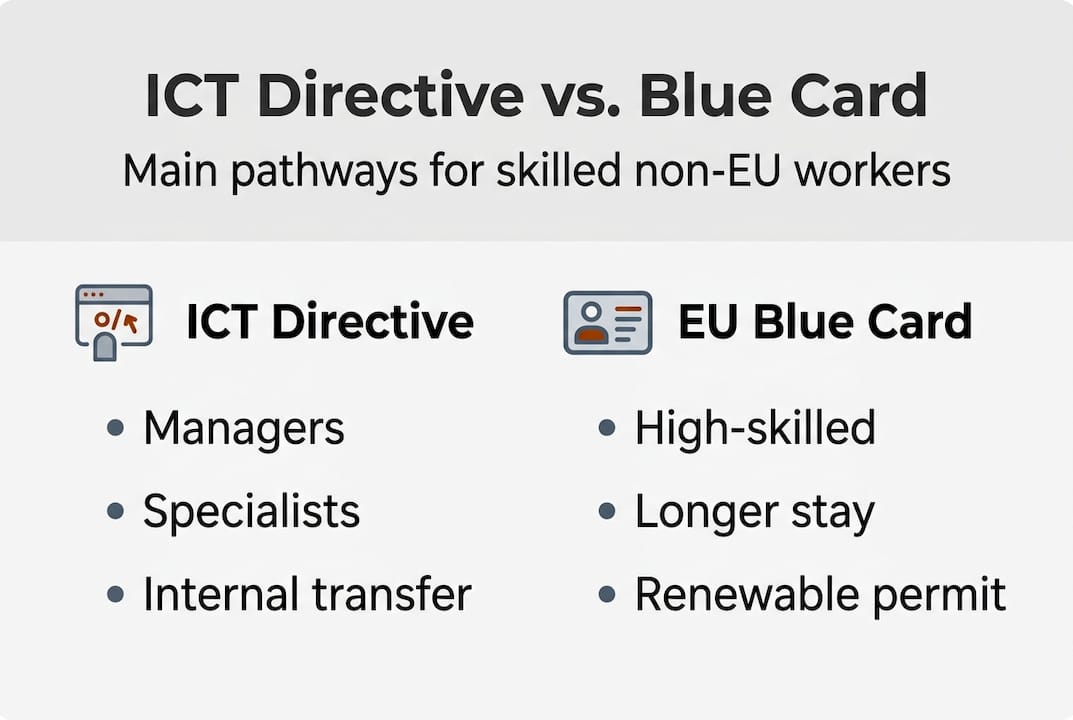
For HR teams evaluating which route to pursue, the ICT Directive is generally preferable for structured internal transfers within a defined corporate group, while the Blue Card offers greater flexibility for external hires and longer-term assignments. Consulting a specialist in mobility programs for workforce relocation early in the planning process reduces the risk of selecting an inappropriate pathway.
Preparing for a successful relocation: requirements and documentation
With a clear understanding of the frameworks, it is essential to prepare the right documents and meet each compliance requirement to ensure a seamless relocation. Both the ICT Directive and the EU Blue Card impose specific prerequisites on the employing company and the individual candidate, and deficiencies in documentation are among the most common causes of application delays or refusals.
For ICT applications, the core documentation requirements include:
- Proof of prior employment within the same corporate group, typically covering 6 to 12 months preceding the transfer date.
- Evidence of company linkage, such as corporate group structure charts, shareholder registers, or intercompany agreements establishing the relationship between the sending and receiving entities.
- Employment contract or assignment letter specifying the role, duration, and terms of the intra-corporate transfer.
- Salary documentation confirming that remuneration meets or exceeds the applicable threshold in the host member state. For example, Ireland’s ICT permit requires a minimum annual salary of approximately €46,000 for most categories.
- Qualifications evidence demonstrating that the employee holds the expertise required for the role.
- Social security documentation, including coordination certificates where applicable, to establish which member state’s social security system applies during the assignment.
For EU Blue Card applications, similar documentation is required, with the addition of recognized higher education credentials or proof of equivalent professional experience, and a binding job offer or employment contract.
Labor market tests, which require employers to demonstrate that no suitable EU national candidate was available for the role, apply in some member states for certain permit categories. HR teams should verify whether this requirement is triggered in the specific host country, as failure to conduct the test where mandated constitutes a grounds for refusal.
Social security coordination deserves particular attention. Under EU Regulation 883/2004, employees working across borders are subject to the social security legislation of one member state at a time. Proper social security registration from the outset prevents double contributions and ensures the employee’s entitlements are correctly established. A detailed social security coordination guide is a practical resource for HR teams navigating multi-country assignments.

Pro Tip: Build a standardized documentation checklist for each target country before initiating any application. Member states frequently impose additional national requirements beyond the minimum EU Directive standards, a practice known as “gold plating,” which can significantly extend processing timelines if not anticipated.
Executing the relocation: step-by-step process for HR teams
Once all requirements and documentation are secured, HR teams must execute the relocation process efficiently to avoid delays and ensure compliance. The sequence of steps differs marginally between the ICT and Blue Card routes, but the core operational logic follows a consistent structure.
- Conduct an eligibility assessment. Before any formal application, verify that the employee meets all criteria: prior employment duration, qualification level, salary threshold, and corporate group linkage for ICT, or employer-employee qualification match for the Blue Card.
- Issue a formal job offer or assignment letter. This document anchors the application and must reflect the terms required by the host member state’s transposition of the relevant directive.
- Compile and authenticate documentation. Gather all required records, arrange translations where needed, and obtain any notarizations or apostilles required by the host country.
- Submit the permit application to the competent authority in the host member state. Processing timelines vary significantly: ICT applications are subject to a 90-day statutory deadline in most states, while Blue Card processing can range from 30 to 90 days depending on jurisdiction.
- Arrange pre-arrival logistics. Coordinate housing, banking setup, and local registration in parallel with the permit process to minimize the gap between permit issuance and operational start.
- Complete in-country registration. Upon arrival, the employee must register with local municipal authorities, obtain a residence document, and complete any employer-side labor law notifications required by the host state.
For the EU Blue Card, the process involves a job offer at or above the applicable salary threshold, followed by the permit application, issuance of the initial residence permit, and eligibility for intra-EU mobility after 12 months of lawful residence. HR teams should calendar this 12-month milestone, as it triggers additional mobility rights that can be leveraged for multi-country assignments.
Pro Tip: Assign a dedicated mobility coordinator or external partner to track each application’s status in real time. Permit applications frequently require supplementary document requests from authorities, and delayed responses are a leading cause of avoidable processing extensions.
“A relocation that is legally sound at the point of entry but inadequately monitored thereafter creates compounding compliance risk. The permit is the beginning of the obligation, not the end.”
A structured relocation compliance guide provides HR teams with a practical framework for managing each stage of the process without gaps.
Verifying compliance after relocation: ongoing obligations for employers
After relocation is complete, compliance checks and ongoing monitoring are essential to avoid fines, loss of permits, or reputational risk. Both the ICT Directive and the EU Blue Card impose continuing obligations on employers that extend well beyond the initial permit issuance.
Key post-relocation compliance obligations include:
- Permit renewal tracking: Both ICT and Blue Card permits carry fixed validity periods. HR teams must establish renewal calendars with sufficient lead time, typically 90 days before expiry, to avoid lapses in legal authorization to work.
- Intra-EU mobility notifications: When an ICT or Blue Card holder moves to a second member state, the employer must notify the competent authority in that state. Failure to do so constitutes a compliance breach even if the underlying permit remains valid.
- Social security reporting: Ongoing social security coordination requires periodic review, particularly when assignment terms change, the employee’s working location shifts, or the assignment extends beyond the original planned duration.
- Labor law adherence: Host-country labor law applies to relocated employees in areas including working time, minimum wage, and health and safety. HR teams must monitor legislative updates in each jurisdiction where employees are stationed.
- Change-of-circumstance reporting: Salary changes, role changes, or employer changes may affect permit validity and must be reported to the relevant authority without delay.
Pro Tip: Implement a centralized mobility tracking system that logs permit expiry dates, mobility notifications, and social security certificate renewals for every relocated employee. A spreadsheet-based approach is adequate for small populations but becomes a liability at scale.
Employers should also be aware of their legal obligations regarding posted workers and secondments, which carry separate notification and documentation requirements distinct from ICT or Blue Card obligations. For assignments involving social security certificates, understanding the updated A1 rules for posted workers is essential to maintaining full compliance across jurisdictions.
Why most HR teams underestimate EU relocation compliance risks
In practice, the most significant compliance failures in EU talent relocation do not occur at the point of application. They occur in the months and years that follow. Incomplete documentation is frequently identified as the trigger for application refusals, but the more consequential risk lies in post-relocation monitoring gaps: missed permit renewals, unnotified intra-EU moves, and social security registration lapses that accumulate undetected until an audit or inspection surfaces them.
HR teams operating without dedicated mobility infrastructure tend to treat relocation as a project with a defined end point, when it is in fact an ongoing compliance obligation. The regulatory environment is not static. Member states update transposition measures, salary thresholds are revised annually, and social security coordination rules are subject to bilateral and EU-level amendments.
Process automation and structured immigration consulting reduce compliance failure rates substantially by removing reliance on manual tracking and individual institutional memory. The EU relocation guide developed for HR teams reflects this operational reality: compliance is a continuous function, not a one-time milestone. Organizations that invest in systematic monitoring frameworks consistently outperform those that treat each relocation as an isolated transaction.
Take your EU talent relocation further with Nestlers Group
For HR leaders managing cross-border talent relocation across the EU, Nestlers Group provides end-to-end support covering permit applications, documentation management, social security coordination, and ongoing compliance monitoring. Whether your organization is deploying employees under the ICT Directive, pursuing EU Blue Card pathways, or managing complex multi-country assignments, Nestlers Group’s international relocation services are structured to reduce administrative burden and compliance exposure at every stage.
Explore the full range of mobility programs available for workforce relocation, or contact Nestlers Group directly to discuss your organization’s specific relocation requirements with an experienced mobility consultant.
Frequently asked questions
What are the main options for relocating non-EU employees to the EU?
The ICT Directive and the EU Blue Card are the primary legal pathways, each suited to different employment relationships and qualification profiles.
What documents are required for an ICT or EU Blue Card application?
Applicants must provide proof of prior employment, evidence of company linkage, salary documentation meeting the applicable threshold, qualification records, and social security coordination certificates as required by the ICT permit compliance framework.
How long can an employee stay in the EU on ICT or Blue Card?
ICT permit holders may remain for up to three years (one year for trainees), while Blue Card holders may stay for up to four years, with renewal options available under both instruments.
What are the most common compliance mistakes HR teams make?
The most frequent errors include incomplete documentation at application, missed permit renewal deadlines, and inadequate social security registration for cross-border employees.
What is intra-EU mobility and how does it work?
Intra-EU mobility allows ICT and Blue Card holders to work in additional member states beyond the one that issued the initial permit, subject to notification requirements and minimum residence periods as defined under the ICT Directive’s mobility provisions.
Recommended
Connect with Nestlers consultants
Do you need immigration and relocation services or consultancy?
It’s easy! Use the below contact form and one of our experts will provide you an answer as soon as possible.
Our consultants can help you in obtaining legal documents and can provide you with assistance regarding the immigration processes, relocation, taxes and payroll, Social Security (European forms A1, S1, U1, etc.) for your employees.