
Many HR professionals and compliance officers assume that a Schengen visa provides broad authorization for employees to work across Europe. This assumption carries significant legal risk. A short-stay Type C visa permits non-EU nationals to enter and travel within the 29 Schengen member states for up to 90 days in any 180-day period, strictly for purposes such as tourism, business meetings, or training, but expressly not for employment. Understanding this distinction is not a procedural formality; it is a foundational compliance requirement for any multinational organization deploying talent across European borders.
Key Takeaways
| Point | Details |
|---|---|
| No work permitted | A Schengen visa does not allow employment, only business or tourist visits. |
| Strict 90/180 rule | Travel is limited to 90 days within any 180-day period across all Schengen states. |
| Compliance is critical | Failure to comply can lead to fines, entry bans, and corporate legal risks. |
| Documentation is vital | Accurate documents and tracking prevent application delays or regulatory issues. |
| Seek expert support | Professional guidance helps HR and compliance managers streamline global mobility. |
What is a Schengen visa and who needs one?
The Schengen visa, formally classified as a Type C short-stay visa, is governed by the EU Visa Code and administered uniformly across all member states participating in the Schengen Agreement. As defined by the Schengen Area Policies of the European Commission, this visa allows non-EU nationals to enter and travel within the 29 Schengen countries for up to 90 days in any 180-day period for purposes such as tourism, business meetings, or family visits, but not for employment. The 29 countries currently include most EU member states plus Iceland, Liechtenstein, Norway, and Switzerland, with Bulgaria, Romania, and Cyprus having recently joined or being in accession processes.
Not every non-EU national requires a Schengen visa. Citizens of countries that hold visa liberalization agreements with the EU, including the United States, Canada, Australia, and many Latin American nations, may enter visa-free for short stays. However, nationals of countries such as India, China, the Philippines, Vietnam, and most African states are required to obtain a visa prior to travel. Additionally, new digital systems such as the Entry/Exit System (EES), scheduled for broader implementation in 2026, will affect how biometric data is registered at borders, regardless of visa exemption status. HR teams should also be aware that ongoing developments in digital Schengen visa procedures will further modernize application and verification processes in coming years.
Permitted activities under a Schengen visa include:
- Attending business meetings, negotiations, or conferences
- Participating in short-term training as a learner (not as a trainer rendering services)
- Conducting market research or due diligence visits
- Tourism and family visits
Activities that are strictly prohibited:
- Rendering employment services or performing work for remuneration
- Taking up residence for extended periods
- Conducting activities that constitute service delivery requiring a work authorization
The distinction between business travel and work authorization is where most compliance failures originate. Attending a client meeting is permissible. Delivering a client project on-site, even for a single day, may constitute employment activity and require the appropriate national work permit. For a practical overview of the boundaries governing business travel in Europe, HR teams should consult current EU guidance.
“A Schengen visa grants entry and short-term presence. It does not grant the right to work. These are legally distinct authorizations, and conflating them exposes both the employee and the employing organization to enforcement actions.”
| Activity | Permitted on Schengen visa | Requires work authorization |
|---|---|---|
| Attending a conference | Yes | No |
| Business meeting with client | Yes | No |
| On-site project delivery | No | Yes |
| Rendering professional services | No | Yes |
| Internal company training (as trainer) | No | Yes |
Core rules: The 90/180-day limit and entry tracking
Having clarified what a Schengen visa is and what it permits, the most operationally significant rule governing its use is the 90/180-day limitation. This rule, which is among the most misunderstood in HR travel management, states that a visa holder may not spend more than 90 days within any rolling 180-day period across all Schengen member states combined. The critical word here is rolling: the 180-day window is not a fixed calendar period but slides backward from any given date of calculation.

According to the EU Short-Stay Calculator, the 90/180 rule counts all Schengen days in any rolling 180-day period, with both entry and exit days counted as full days of presence. Multiple short-term trips do not reset the count. An employee who travels to Germany for five days, then to France for four days three weeks later, then to the Netherlands for seven days in the following month has accumulated 16 Schengen days, all of which fall within the rolling calculation.
The practical steps HR teams should follow to monitor compliance are as follows:
- Record every entry and exit date for each employee traveling to Schengen countries.
- On any given review date, count backward 180 calendar days to identify the relevant window.
- Sum all days spent within Schengen territory during that window, counting both arrival and departure days.
- Confirm the total does not exceed 90 days.
- Flag employees approaching 75 days of presence for early intervention and travel restructuring.
- Use the EU short-stay calculator as a secondary verification tool before approving additional trips.
| Threshold | Recommended HR action |
|---|---|
| 0 to 60 days | Routine monitoring |
| 61 to 75 days | Heightened review, flag for compliance team |
| 76 to 89 days | Travel freeze pending legal assessment |
| 90 days reached | No further Schengen travel until window resets |
Exceeding the 90-day limit exposes the employee to fines, entry refusal, and travel bans, while the sponsoring employer may face regulatory scrutiny and reputational consequences. With Schengen developments accelerating in 2026, including the planned rollout of the EES biometric tracking system, border authorities will have automated real-time data on every traveler’s entry and exit history across all Schengen states.
Pro Tip: Build the 90/180-day tracking logic directly into your travel management or HRMS platform. Automated alerts at 75 days of Schengen presence allow compliance teams to intervene before a violation occurs, rather than responding to one.
Application process and required documents
With a clear understanding of the visa’s operational rules, HR professionals need a structured approach to supporting employees through the application process. The Schengen visa is applied for at the consulate of the country that constitutes the main destination, meaning the country where the employee will spend the most days during the trip. If no single country is the predominant destination, the application is filed with the consulate of the first country of entry.
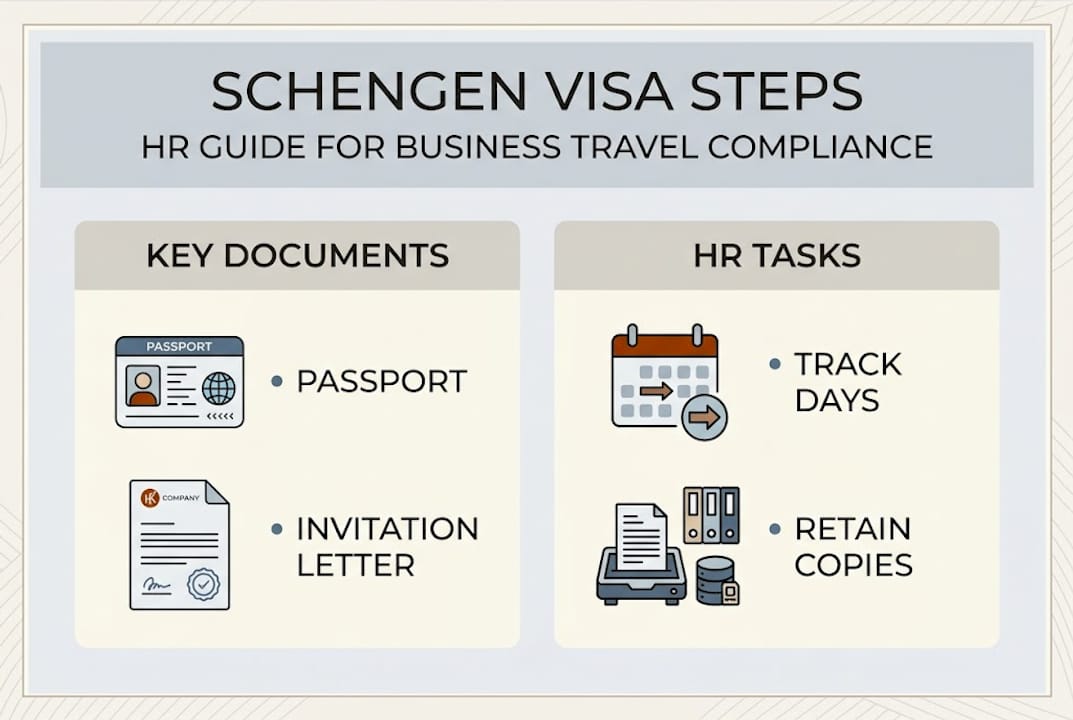
Under EU Schengen Visa Policy, applications are submitted to the consulate of the main destination country, with standard processing taking approximately 15 days but potentially extending to 45 days during peak periods or for cases requiring additional documentation. For HR teams coordinating employee travel around business events, this timeline must be factored into project schedules well in advance.
The core required documents for a business Schengen visa application are:
- A valid passport with at least two blank pages and validity extending three months beyond the intended stay.
- A completed Schengen visa application form, signed by the applicant.
- Two recent passport-sized photographs meeting Schengen photo standards.
- Travel insurance with a minimum coverage of €30,000, valid across all Schengen states for the duration of the trip.
- Proof of sufficient financial means for the stay (bank statements, employer guarantee letters).
- A formal business invitation letter from the host company, specifying the purpose, dates, and nature of the visit.
- Proof of accommodation (hotel reservations or host company letter confirming arrangements).
- Round-trip flight reservations or travel itinerary.
HR teams should retain copies of all submitted documentation for each employee, as this forms part of the employer’s compliance record. Evolving digital application trends are gradually introducing online submission portals and electronic verification, which will reduce processing friction in coming years. For organizations managing high volumes of business travel, structured visa and immigration support can significantly reduce administrative burden and error rates.
Pro Tip: Prepare business invitation letters using a standardized template reviewed by legal counsel. A vague or inconsistent invitation letter is among the leading causes of Schengen visa refusals for business travelers.
Common compliance pitfalls and best practices for HR
Armed with practical application knowledge, HR and compliance teams must also understand where organizations most frequently fail in managing Schengen visa use. Errors in this domain are not merely procedural; they carry legal, financial, and reputational consequences.
The most common compliance failures include:
- Allowing employees to perform work activities, including remote work for non-EU employers, while present in the Schengen area on a short-stay visa
- Failing to track cumulative Schengen days across multiple short trips, leading to unintentional overstays
- Submitting business invitation letters that inaccurately describe the employee’s actual activities
- Assuming that visa-exempt nationals are not subject to the 90/180-day limit (they are)
- Neglecting to verify visa validity and entry conditions before each trip
As confirmed by Schengen Area enforcement, a Schengen visa does not authorize employment, and working without proper permits can result in fines and travel bans that affect both the individual and the organization. For employers, the consequences may extend to prohibition from sponsoring future visa applications.
HR teams should also review their legal obligations for EU delegations to understand how posted worker rules intersect with short-stay visa travel, particularly when employees are based in one EU country and traveling to another for project delivery. Additionally, recent Schengen visa rule updates have introduced expanded eligibility for certain nationalities, requiring compliance teams to stay current on bilateral agreements.
Recommended HR best practices:
- Conduct a pre-trip compliance check for every non-EU national traveling to Schengen countries, regardless of the trip’s apparent simplicity
- Train line managers to recognize the difference between permissible business travel and activities requiring work authorization
- Retain all visa documentation, invitation letters, and travel records for a minimum of five years
- Designate a central compliance contact for Schengen travel queries
Pro Tip: Establish a centralized travel log that records each employee’s Schengen entry and exit dates, visa type, and purpose of visit. This log is your primary defense in the event of an audit or border authority inquiry.
Why Schengen visa compliance is more complex than it appears
Many organizations treat Schengen visa compliance as a checklist exercise: confirm visa type, check expiry date, approve travel. This approach is increasingly inadequate. Enforcement capacity across Schengen member states is expanding, and digital infrastructure such as the EES will make real-time verification routine rather than exceptional. The era of undetected overstays or undocumented work activities is effectively ending.
What experienced mobility practitioners observe is that the most significant compliance failures rarely involve obvious violations. They arise from ambiguous situations: an employee attends a client meeting that transitions into a project kick-off workshop; a trainer participates in what was documented as a passive training session but delivers content; a remote worker logs in from a hotel in Amsterdam for two weeks while on what was categorized as a business trip. These gray areas require policy frameworks, not ad hoc judgments.
Organizations that invest in structured business immigration workflows with clear activity classification criteria, documented pre-approval processes, and centralized tracking systems are materially better positioned to withstand regulatory scrutiny. Compliance in this domain is not a static state; it requires continuous monitoring, periodic policy review, and access to current regulatory intelligence.
Streamline your company’s global mobility with expert support
Navigating Schengen visa compliance alongside broader workforce mobility requirements demands more than internal process management. Nestlers Group provides end-to-end global mobility solutions tailored to the operational realities of HR and compliance teams in multinational organizations. From visa documentation support and days-tracking frameworks to full immigration lifecycle management, Nestlers removes the regulatory uncertainty that often accompanies cross-border workforce deployment. For organizations managing employees across multiple European jurisdictions, the international relocation services offered by Nestlers provide structured, compliant, and efficient pathways for both short-term business travel and long-term assignments. Contact Nestlers Group to discuss a tailored compliance and mobility strategy for your organization.
Frequently asked questions
Does a Schengen visa allow an employee to work in Europe?
No. A Schengen visa is not valid for employment and only permits short stays for business meetings or attendance at events, not for productive work or service delivery in any Schengen country.
How do employers calculate the 90/180-day rule?
Employers must sum all days spent in Schengen countries within any rolling 180-day window; the 90/180 rule counts all Schengen days in that period, including multiple trips, and the total must not exceed 90 days.
What documents are essential for a business Schengen visa application?
Key documents include a valid passport, completed application form, photo, travel insurance and invitations meeting EU standards, proof of funds, and a formal business invitation letter from the host organization.
Are there electronic systems tracking employees’ Schengen visa use?
Yes. The Entry/Exit System (EES) tracks biometrics automatically for all Schengen entries and exits, providing border authorities with real-time travel history data for every traveler.
Recommended
- Essential immigration procedures for HR: EU corporate guide
- Proposal of digitalisation for the Schengen visa procedures – Nestlers Group
- EU social security coordination for expatriates: 2026 guide
- How to hire foreign employees: a complete compliance guide
- Zeitarbeit Compliance Checkliste: Rechtssicherheit für Unternehmen
Connect with Nestlers consultants
Do you need immigration and relocation services or consultancy?
It’s easy! Use the below contact form and one of our experts will provide you an answer as soon as possible.
Our consultants can help you in obtaining legal documents and can provide you with assistance regarding the immigration processes, relocation, taxes and payroll, Social Security (European forms A1, S1, U1, etc.) for your employees.