
Many HR and compliance managers at multinational companies assume that the EU’s push toward a unified work and residence permit has already simplified non-EU hiring in Romania. That assumption carries real operational risk. The EU Single Permit Directive (2011/98/EU, recast 2024/1233) establishes a combined residence and work authorization for third-country nationals, with Member States required to transpose the recast by May 2026. Romania, however, continues to operate a multi-step process in practice. This guide provides current, compliance-focused clarity on what HR teams must actually do to hire non-EU nationals in Romania today and how to prepare for the regulatory transition ahead.
Key Takeaways
| Point | Details |
|---|---|
| EU Directive goal | The Single Permit directive aims to simplify hiring processes for non-EU talent across member states. |
| Romanian process status | Romania’s system remains multi-step in 2026, requiring separate work and residence steps for non-EU hires. |
| Employer responsibilities | Employers must handle permit applications, pay all associated fees, and comply with digital and quota regulations. |
| Transition tips | HR managers should start early, follow legal updates on the recast, and use digital platforms for applications. |
| Future readiness | Preparing compliance routines now helps HR teams adapt quickly when Single Permit reforms go live in Romania. |
Understanding the EU Single Permit Directive and its impact
The EU Single Permit Directive was designed to reduce administrative fragmentation across Member States by creating one combined document that grants both the right to reside and the right to work. Under the recast 2024/1233 framework, the application process is intended to be submitted through a single competent authority, with a defined processing window and equal treatment guarantees for non-EU workers relative to nationals.
For HR managers accustomed to managing separate visa, work authorization, and residence permit workflows, this sounds like a significant administrative relief. The critical point, however, is that the directive sets a framework obligation. It does not self-execute. Each Member State must enact domestic legislation to give the directive legal force at the national level, a process known as transposition.
As of April 2026, no full recast implementation has been confirmed in Romania. The country’s process remains sequential and multi-step, requiring employers to navigate distinct authorization, visa, and permit stages. HR departments that have planned timelines based on an assumed single-window process will encounter delays and compliance gaps.
The table below illustrates the contrast between the EU directive’s intended model and Romania’s current operational reality:
| Dimension | EU Single Permit (directive intent) | Romania current process (2026) |
|---|---|---|
| Application window | Single competent authority | Multiple authorities (IGI, consulates) |
| Document issued | One combined permit | Separate work auth, visa, residence permit |
| Processing timeline | Defined statutory period | 30-45 days for work auth plus additional stages |
| Employer obligation | Single application submission | Sequential filings at each stage |
| Digital platform | Member State discretion | WorkinRomania.gov.ro portal in development |
Key regulatory implications for HR teams include:
- The recast directive’s equal treatment provisions will, once transposed, extend additional labor rights to permit holders.
- Romania’s current quota system and labor market test requirements are not eliminated by the directive; they remain national prerogatives.
- The anticipated shift to a single procedure may reduce total processing time, but the transition period introduces its own compliance complexity.
For a detailed analysis of how Romania’s 2026 law changes interact with the directive’s transposition timeline, HR managers should review current domestic regulatory guidance alongside EU-level obligations.
Current permit process in Romania for non-EU hires
Understanding Romania’s actual hiring process is essential for any multinational employer operating in the country. The process is employer-driven, quota-constrained, and sequential. Each stage must be completed before the next can begin, which means errors or omissions at any point reset the timeline.
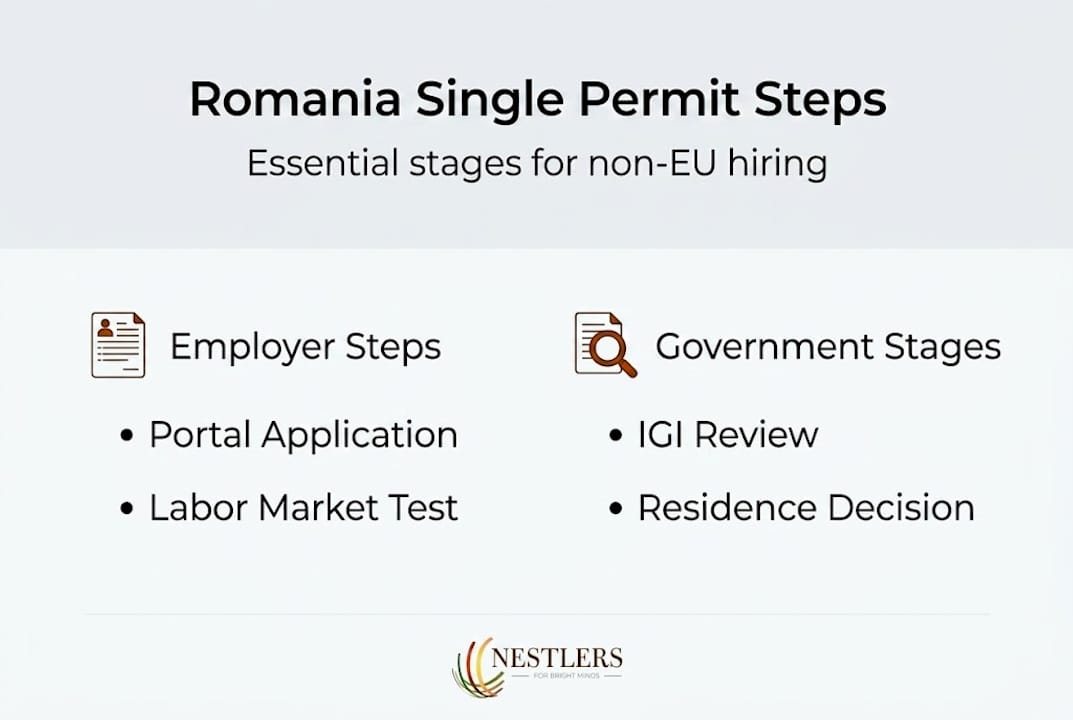
According to the EU immigration portal, non-EU workers currently require a separate employer-sponsored work authorization (aviz de angajare) from the General Inspectorate for Immigration (IGI), followed by a long-stay D/AM visa, and then a temporary residence permit (permis de sedere temporara) that combines residence and work rights. The following numbered sequence reflects the standard workflow:
- Labor market test. The employer must advertise the position for a minimum of 15 days and demonstrate that no Romanian or EU candidate is available. Documentation must be retained for audit purposes.
- Work authorization application (aviz de angajare). Filed at IGI, this stage takes 30-45 days for processing. The employer must prove no outstanding tax debts, a compliant employment contract, and adherence to quota availability.
- Long-stay D/AM visa. The non-EU national applies at the Romanian consulate in their country of origin. Processing times vary by jurisdiction.
- Temporary residence permit. After entry, the worker applies for the permis de sedere temporara, which formalizes combined residence and work rights.
Quota context: Romania issued approximately 50,000 work permits in 2025. The 2026 quota is set at 90,000, reduced from 100,000 in prior years, reflecting a tightening of national admission policy.
The table below provides timeline benchmarks for planning purposes:
| Stage | Responsible party | Estimated duration |
|---|---|---|
| Labor market test | Employer | 15+ days |
| Work authorization (IGI) | Employer | 30-45 days |
| D/AM visa processing | Employee (consulate) | 15-30 days (varies) |
| Residence permit | Employee (IGI post-entry) | 30 days |
| Total estimated timeline | 90-120 days |
All employer applications must be submitted through the WorkinRomania.gov.ro digital portal. Paper submissions are no longer accepted for the work authorization stage. Employers must also comply with the employer pays principle, meaning that no application fees or migration costs may be charged to or deducted from the worker. For staffing agencies, a financial guarantee is required as a condition of filing on behalf of client employers.
Pro Tip: Employers hiring workers from countries with limited Romanian consular presence, such as parts of South Asia or Sub-Saharan Africa, should factor consular appointment availability into their total timeline estimate. In some jurisdictions, visa appointment slots are booked weeks in advance, adding material delay to the overall process.
For the most current guidance on immigration law updates affecting non-EU hires, including recent regulatory amendments, HR teams should consult updated compliance resources regularly. Companies that do not yet have a Romanian legal entity may also consider hiring without an entity through an Employer of Record structure, which transfers the compliance burden to a locally established provider.
Compliance challenges and best practices for HR management
Romania’s permit process presents several compliance risks that are disproportionately likely to affect multinational employers unfamiliar with the local regulatory environment. The following are the most frequently encountered pitfalls observed in practice:
- Insufficient labor market test documentation. IGI requires evidence of active recruitment efforts, including job advertisement copies, response logs, and written justification for rejecting Romanian or EU candidates. Incomplete documentation is a common cause of work authorization refusal.
- Contract non-compliance at the time of application. The employment contract submitted with the work authorization application must reflect actual agreed terms, including salary at or above the applicable minimum wage. Amendments after submission require re-filing in some cases.
- Quota exhaustion. The 90,000 permit quota for 2026 is allocated on a first-come, first-served basis. Employers who delay applications until the second half of the year risk finding the quota depleted, particularly in high-demand sectors such as construction, manufacturing, and logistics.
- Portal registration delays. First-time users of the WorkinRomania.gov.ro platform must complete an employer registration process before submitting applications. This registration step is often overlooked in project planning.
- Agency compliance gaps. Staffing agencies that fail to maintain the required financial guarantee or that inadvertently charge fees to workers expose both themselves and the client employer to regulatory sanction.
The employer pays principle is enforced with increasing rigor, and IGI’s online portal is now the mandatory channel for all work authorization submissions. Employers must also ensure that the worker’s employment contract is registered in the REVISAL system (Romania’s national employment register) within the statutory deadline following the residence permit issuance.

For multinationals managing volume hiring across multiple non-EU source countries, compliant hiring in Romania requires a structured internal workflow that assigns clear ownership for each permit stage, tracks quota consumption in real time, and maintains audit-ready documentation throughout.
Pro Tip: Batch your work authorization applications in the first quarter of the year. Quota consumption accelerates significantly from April onward as employers in labor-intensive sectors submit high-volume filings. Early submission maximizes the probability of approval within the annual allocation.
Employers should also note that the recast directive may reduce procedural steps once transposed, but the compliance obligations around labor market testing, contract verification, and quota adherence are national prerogatives that will persist regardless of the single permit procedure’s introduction.
Future outlook: Romania’s transition to a streamlined Single Permit
The May 2026 transposition deadline for the recast directive creates a defined regulatory horizon for HR planning. If Romania completes transposition within this window, the procedural architecture for non-EU work permits could change materially, consolidating the current multi-stage process into a single application submitted to one competent authority.
However, as of April 2026, Romania’s process remains multi-step, and a draft ordinance for managing foreign worker admissions through a single national digital platform is still in development. This signals regulatory intent without confirmed operational readiness. HR managers should treat the May 2026 deadline as a planning trigger rather than a confirmed implementation date.
The following actions are recommended for HR and compliance teams preparing for this transition:
- Audit current permit workflows to identify which steps would be affected by a single-window procedure and where internal process changes will be required.
- Monitor the IGI and Ministry of Labor websites for official transposition notices, implementing regulations, and platform launch announcements.
- Review employment contracts and onboarding documentation to ensure they align with the equal treatment provisions that the recast directive will introduce for permit holders.
- Engage with the labor shortage occupations list, which is updated periodically and determines which roles may benefit from expedited or simplified authorization procedures.
- Assess digital platform readiness by ensuring that employer accounts on WorkinRomania.gov.ro are active and that internal HR staff are trained on the portal’s current functionality.
Pro Tip: Monitor updates to Romania’s shortage occupation list closely. Roles included on this list may qualify for reduced labor market test requirements or prioritized quota allocation, which can materially shorten the authorization timeline for eligible positions.
The transition to a true single permit procedure, once implemented, will represent a genuine operational improvement for multinational employers. However, the interim period, during which domestic legislation is being drafted and digital infrastructure is being built, carries its own compliance risks. Employers who maintain robust internal processes now will be better positioned to adapt when the 2026 hiring law changes take effect.
Our perspective: What most guides miss about the Single Permit transition
Most commentary on the Single Permit focuses on the directive’s eventual benefits, reduced paperwork, faster processing, and a single point of contact. What receives less attention is the transition risk that exists between legislative intent and operational reality.
Romania’s immigration infrastructure has historically required time to absorb regulatory change. New digital platforms, revised IGI procedures, and updated employer obligations do not become functional on the day a law is published. HR departments that restructure their permit workflows in anticipation of a streamlined process, before that process is actually operational, risk creating compliance gaps in the interim.
The more durable lesson from working with employers across multiple regulatory cycles is this: compliance routines built around current requirements are more reliable than those built around anticipated simplifications. The EU immigration portal confirms that official sources align on the current multi-step process remaining in force until transposition is complete. That confirmation should anchor HR planning decisions.
Investing now in structured permit management, quota tracking, and documentation standards will reduce risk regardless of when the single permit procedure arrives. Companies hiring Asian talent in Romania across high-volume pipelines will find that operational discipline built under the current system translates directly into readiness for the reformed one.
Connect with expert mobility solutions for Romania
Managing non-EU work permits in Romania requires precise coordination across IGI filings, labor market testing, quota tracking, and digital platform submissions. Nestlers Group provides end-to-end support for the entire permit lifecycle, from initial work authorization through residence permit issuance and ongoing compliance monitoring. Our non-EU recruitment solutions integrate sourcing, immigration, and relocation into a single managed workflow, reducing administrative burden on internal HR teams. For organizations seeking to assess their current compliance posture, our workforce mobility audit guide provides a structured framework for identifying gaps. To discuss your specific hiring requirements, contact our mobility experts directly.
Frequently asked questions
Does Romania have a true Single Permit process for non-EU hires in 2026?
No, Romania still requires separate sequential steps for work authorization, visa, and residence permit. Full recast implementation is anticipated but had not been confirmed as of April 2026.
What is the quota for work permits in Romania in 2026?
Romania’s 2026 quota is 90,000 work permits for non-EU nationals, reduced from 100,000 in prior years, allocated on a first-come, first-served basis.
How long does it take to secure a work permit for a non-EU employee?
Employers should plan for 30-45 days for IGI work authorization processing alone, with the full permit workflow typically requiring 90 to 120 days from start to finish.
Are workers responsible for permit application fees in Romania?
No. The employer pays principle is enforced in Romania, meaning all permit fees must be covered by the employer, and staffing agencies must maintain a financial guarantee when filing on behalf of clients.
How can HR managers prepare for the recast Single Permit implementation?
HR teams should audit current permit workflows, monitor official IGI and Ministry of Labor announcements, and maintain active accounts on the WorkinRomania.gov.ro portal to adapt promptly when Romania transposes the recast by May 2026.
Recommended
- Employer of Record (EOR) in Romania: Hire Employees Without a Local Entity (2026 Guide) – Nestlers Group
- Guide to Romania’s 2026 law changes for hiring non-EU citizens
- Ensuring Transparency in Employment Contracts: A Guide to Article 17 and Article 18 of the Romanian Labor Law – Nestlers Group
- Employer of Record Romania: The Smartest Way to Hire and Stay Fully Compliant – Nestlers Group
Connect with Nestlers consultants
Do you need immigration and relocation services or consultancy?
It’s easy! Use the below contact form and one of our experts will provide you an answer as soon as possible.
Our consultants can help you in obtaining legal documents and can provide you with assistance regarding the immigration processes, relocation, taxes and payroll, Social Security (European forms A1, S1, U1, etc.) for your employees.