
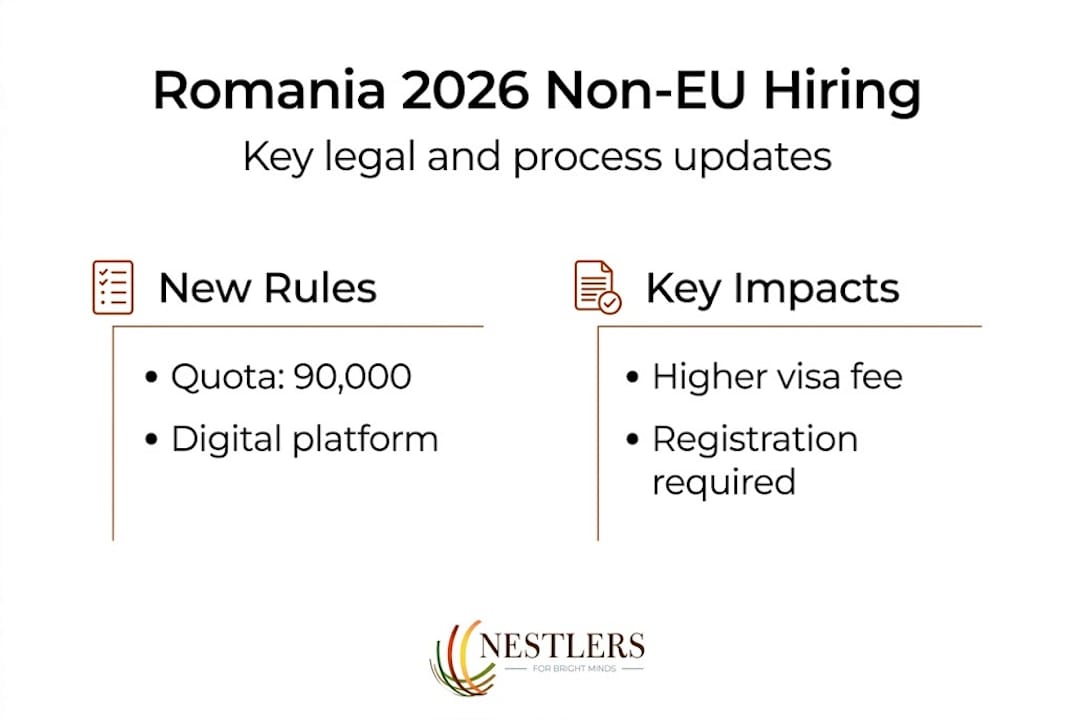
Romania’s annual quota for non-EU workers dropped to 90,000 in 2026, down from 100,000 the previous year, and that reduction is only one part of a substantially more complex regulatory picture. Alongside the quota adjustment, the government has introduced mandatory employer registration, a centralized digital platform, stricter recruitment agency requirements, bilingual contract obligations, and a significant increase in consular visa fees. For HR managers and compliance officers responsible for non-EU hiring, understanding each of these changes in sequence is essential to maintaining lawful operations and avoiding costly processing delays throughout the year.
Key Takeaways
| Point | Details |
|---|---|
| Quota reduced | The maximum number of new non-EU workers in 2026 is 90,000, lowering available slots and increasing competition. |
| Mandatory digital registration | All employers must register and submit single applications via the new WorkinRomania.gov.ro platform. |
| More employer responsibilities | Onboarding now requires bilingual contracts, bank transfers for salaries, and six months of training support. |
| Higher compliance checks | Agencies face stricter requirements, and companies must be audit-ready throughout the hire and retention process. |
| Visa and onboarding cost changes | Visa fees rose substantially, so employers must budget for higher upfront costs per non-EU hire. |
Understanding Romania’s 2026 quota and labor market context
The 2026 quota reduction to 90,000 does not reflect a straightforward tightening of labor market access. Rather, it represents a recalibration of how Romania manages non-EU workforce admission, with greater emphasis on matching authorizations to verified labor shortages rather than issuing permits broadly. The practical effect for employers is that competition for available slots will be more structured, and applications that do not align with documented sector needs face a higher risk of rejection or delay.
Empirical data from 2025 illustrates the underlying pressure. Over 83,000 work authorizations were issued by September of that year, against a backdrop of more than 400,000 registered vacancies nationally. Construction, HoReCa (hotels, restaurants, and catering), and transport remained the hardest-hit sectors, each recording vacancy rates that domestic labor supply could not address. The 2026 reforms are designed to redirect quota allocations toward these verified shortage areas through a national shortage occupation list, rather than allowing authorizations to accumulate in sectors with lower demonstrated need.

The table below summarizes the quota trajectory and key labor market indicators:
| Year | Quota | Authorizations issued (by Sep) | Registered vacancies |
|---|---|---|---|
| 2024 | 100,000 | ~79,000 | ~380,000+ |
| 2025 | 100,000 | 83,000+ | 400,000+ |
| 2026 | 90,000 | Pending | Ongoing |
“The 2026 reforms target real skills needs via a shortage occupation list, aiming to reduce permit issuance that does not correspond to verified labor demand.” This shift in policy logic means that employers in construction, logistics, and hospitality are likely to retain priority access, while those in sectors with less documented shortage may find authorization more difficult to secure.
For employers seeking to understand how Romania’s non-EU labor market connects to broader EU-level initiatives, the EU talent pool framework provides relevant context on how member states are coordinating international recruitment strategies.
Key sector considerations for 2026 quota planning:
- Construction and infrastructure projects retain strong priority under the shortage list framework
- HoReCa operators face seasonal demand spikes that the quota system must accommodate
- Transport and logistics companies should document labor shortages formally to support authorization requests
- Manufacturing sectors with documented skill gaps may qualify for expedited processing
Employer registration and application compliance: What’s new?
One of the most operationally significant changes in 2026 is the introduction of mandatory employer registration in an official register before any non-EU hiring process can commence. This requirement applies to all employers regardless of company size, sector, or prior hiring history. The registration approval period may extend to 30 working days, which translates to approximately six calendar weeks under standard business conditions.
The second major procedural change is the replacement of the traditional work permit (aviz de muncă) with a single application mechanism. Under the previous system, employers and workers navigated separate administrative tracks for the work authorization and the residence permit. The single application consolidates these into one coordinated procedure, reducing duplication but also raising the stakes for file completeness at the point of submission.
Comparison of old and new application processes:
| Element | Previous process | 2026 process |
|---|---|---|
| Employer registration | Not required | Mandatory, up to 30 working days |
| Work authorization | Separate aviz de muncă | Consolidated single application |
| Residence permit | Separate track | Integrated into single application |
| Platform | Paper and in-person | Digital via WorkinRomania.gov.ro |
Steps every employer must complete before submitting a non-EU hiring application in 2026:
- Register the company in the official employer register through the WorkinRomania.gov.ro platform
- Allow sufficient lead time for the 30-working-day approval period before any intended start date
- Confirm the target role appears on the national shortage occupation list or qualifies under an exemption
- Prepare a complete documentation file, including the employment contract draft, proof of salary compliance, and evidence of labor market testing where required
- Submit the single application through the digital platform, ensuring all documents meet format and language requirements
Pro Tip: Build the 30-working-day registration window into your recruitment timeline from the outset. Employers who treat registration as a parallel task rather than a prerequisite frequently encounter delays that push back the entire hiring schedule by two months or more.
For a detailed review of how these procedural changes interact with existing immigration law updates in Romania, and how to structure internal processes for staying fully compliant, specialist guidance is strongly advisable before the first application is filed.
Digital transformation: Using WorkinRomania.gov.ro and modernized workflows
The WorkinRomania.gov.ro platform now serves as the centralized point of entry for all non-EU hiring processes in Romania, covering employer registration, single application submission, document management, and case tracking. The transition to a fully digital workflow represents a structural shift in how immigration administration operates, and it carries both efficiency benefits and new compliance risks for employers who are not adequately prepared.
The platform’s primary advantages include real-time status tracking for submitted applications, standardized document checklists that reduce the risk of incomplete submissions, and a centralized record of all employer activity that can be referenced during audits or inspections. Employers who previously managed paper-based processes will find that the digital system imposes stricter formatting requirements and leaves less room for informal correction after submission.
Common errors that HR teams should actively avoid when using the platform:
- Uploading documents in unsupported file formats or exceeding size limits, which causes automatic rejection of the submission
- Failing to complete all mandatory fields in the employer registration form before proceeding to the application stage
- Submitting applications before registration approval is confirmed, which invalidates the application and restarts the timeline
- Using outdated document templates that do not reflect 2026 regulatory requirements
- Neglecting to monitor the platform regularly for status updates or requests for additional information from the processing authority
Pro Tip: Assign a dedicated internal contact responsible for platform monitoring. Applications that receive information requests from the processing authority typically have a short response window, and missed deadlines result in case closure rather than extension.
The broader trend toward digital immigration administration in Europe, including the visa digitalization proposal at the Schengen level, indicates that Romania’s platform transition aligns with EU-wide modernization objectives. Employers managing hiring in Romania at scale, or those considering hiring remote staff with cross-border elements, should integrate platform management into their standard HR operating procedures.
Recruitment agency regulation and sector exemptions
The 2026 reforms introduce substantially stricter authorization requirements for recruitment agencies operating in the non-EU hiring space. Agencies are now required to demonstrate financial guarantees scaled to the volume of workers they place. For agencies handling up to 1,000 workers, the required financial guarantee is set at €200,000. This requirement is intended to reduce the prevalence of non-compliant intermediaries and to ensure that agencies bear financial accountability for the workers they introduce to the Romanian labor market.
“The introduction of scaled financial guarantees for recruitment agencies reflects a regulatory intent to professionalize the intermediary market and reduce exploitation risks for non-EU workers entering Romania.”
The practical consequence for employers is that agency-based hiring is likely to become the dominant model for bulk and high-need sector recruitment, as agencies with proper authorization will offer a more reliable compliance pathway than direct employer applications in complex cases. Employers who previously managed non-EU recruitment independently should assess whether the 2026 registration and documentation requirements make agency partnership more operationally efficient.
Key points on agency regulation and exemptions:
- Agencies must obtain and maintain authorization under the new framework before placing non-EU workers
- Financial guarantee requirements scale with worker volume, creating a tiered compliance structure
- Agencies that fail to meet guarantee thresholds face suspension of authorization and cannot legally place workers
- Highly qualified workers, researchers, and seasonal employees from specific countries may be exempt from the quota entirely, meaning their authorization does not consume a slot from the 90,000 allocation
- Intra-company transferees and certain categories of posted workers may also fall outside the standard quota framework
For employers evaluating whether to use an agency or manage applications directly, a review of available non-EU recruitment solutions and EOR in Romania options provides a structured basis for that decision.
Onboarding, contracts, and visa fees: What to prepare for in 2026
The 2026 regulatory framework imposes several new obligations at the onboarding and employment contract stage that HR teams must integrate into standard hiring workflows. Employment contracts must now be bilingual, with Romanian and the worker’s language both represented. Salaries must be paid exclusively via bank transfer, eliminating cash payment arrangements that were previously tolerated in some sectors. Employers are also required to ensure equal treatment between non-EU workers and comparable Romanian employees in terms of pay, working conditions, and access to benefits.
> Consular visa fee increase: The fee for work visas issued at Romanian consulates has risen from €120 to €300 for 2026, representing a 150% increase that must be factored into per-hire cost projections.
Additional mandatory obligations introduced in 2026:
- Employers must report to the General Inspectorate for Immigration if a non-EU worker fails to appear for work or abandons the position, within a defined reporting window
- Language and cultural integration training must be provided for a minimum of six months following the worker’s arrival
- Payroll records for non-EU employees must be maintained in a format accessible for inspection by labor and immigration authorities
- Employment contracts must specify the exact role, work location, and salary in terms that comply with Romanian labor law minimums
Pro Tip: The bilingual contract requirement is not satisfied by a simple translation appended to a Romanian original. Both language versions must be legally equivalent, and any discrepancy between versions may create enforceability issues. Legal review of contract templates before the first hire is strongly recommended.
The consular fee increase from €120 to €300 per worker has a direct impact on budget planning for companies hiring at volume. An employer bringing in 50 non-EU workers in 2026 will face €15,000 in consular fees alone, compared to €6,000 under the previous fee structure. For detailed guidance on how these costs interact with payroll and tax obligations, a review of current payroll regulations in Romania is advisable.
What most companies miss about the 2026 reforms
The standard compliance response to regulatory change focuses on documentation checklists and deadline management. That approach, while necessary, is insufficient for the 2026 reforms because the changes are not purely procedural. They impose substantive obligations on employers that extend well beyond the point of hire, including six months of mandatory language and cultural training, ongoing reporting duties, and financial accountability for worker outcomes.
Companies that treat the 2026 framework as an administrative update rather than an operational shift will encounter compliance gaps that emerge during inspections rather than at the application stage. The bilingual contract requirement, the bank transfer salary rule, and the missing worker reporting obligation are all areas where non-compliance is difficult to detect internally but straightforward for labor inspectors to identify.
The more consequential risk is retention. Non-EU workers who arrive without adequate integration support, language training, or clear employment terms are significantly more likely to abandon positions within the first three months, triggering both reporting obligations and the loss of the quota slot. Proactive investment in onboarding quality directly reduces this risk. An internal HR audit that maps current processes against the 2026 requirements, or engagement with a specialist partner for EOR compliance strategies, will surface gaps before they become enforcement issues.
Partner with experts for compliance and efficiency
Navigating Romania’s 2026 non-EU hiring framework requires more than familiarity with the new rules. It requires operational infrastructure capable of managing registration timelines, digital platform submissions, bilingual contract preparation, payroll compliance, and ongoing reporting obligations simultaneously. Nestlers Group provides global mobility solutions that cover the full lifecycle of non-EU worker admission, from initial employer registration through to integration and retention support. For companies that need to scale non-EU hiring efficiently, non-EU recruitment services offer an end-to-end pipeline covering sourcing, immigration, and relocation. A structured workforce mobility audit can also identify compliance gaps before they result in enforcement action or processing delays.
Frequently asked questions
What is the new non-EU worker quota for Romania in 2026?
The quota is set at 90,000 new non-EU workers for 2026, reduced from 100,000 the previous year, with allocations prioritized toward verified shortage sectors.
Do all employers need to register before hiring non-EU workers in Romania?
Yes, registration in the official register is mandatory for all employers and must receive formal approval, which may take up to 30 working days, before any non-EU hiring application can be submitted.
How does the new WorkinRomania.gov.ro platform change the hiring process?
The WorkinRomania.gov.ro platform centralizes all stages of the non-EU hiring process, including employer registration, single application submission, document management, and real-time case tracking, replacing previous paper-based and fragmented procedures.
What is the new consular visa fee for non-EU workers?
The consular fee for work visas increased from €120 to €300 in 2026, a change that has significant budget implications for employers hiring at volume.
Are there exceptions to the quota for hiring non-EU workers?
Yes, highly qualified workers, researchers, and certain seasonal employees from specific countries are exempt from the quota, meaning their authorizations do not count against the 90,000 annual allocation.
Recommended
- EU Council Approves New Single Work and Stay Permit for Non-EU Citizens – Nestlers Group
- Employer of Record (EOR) in Romania: Hire Employees Without a Local Entity (2026 Guide) – Nestlers Group
- Latest Immigration Law Updates in Romania for Non-EU Citizens – Nestlers Group
- 10 Proposed Changes in the legislation regarding the regime of foreigners in Romania – Nestlers Group
Connect with Nestlers consultants
Do you need immigration and relocation services or consultancy?
It’s easy! Use the below contact form and one of our experts will provide you an answer as soon as possible.
Our consultants can help you in obtaining legal documents and can provide you with assistance regarding the immigration processes, relocation, taxes and payroll, Social Security (European forms A1, S1, U1, etc.) for your employees.