
Multinational companies operating across Romania and the EU face a compliance environment that leaves little margin for error. A single lapse in work permit validity, a missing posted worker notification, or an inconsistent payroll record can trigger regulatory investigations, financial penalties, and reputational damage that is difficult to reverse. This guide provides HR managers and compliance officers with a structured, practical audit framework covering assessment, preparation, execution, and continuous improvement, specifically designed for workforce mobility programs operating within Romanian and broader EU legal contexts.
Key Takeaways
| Point | Details |
|---|---|
| Preparation is vital | Gather all stakeholder inputs and documentation before starting the audit for maximum efficiency. |
| Follow clear steps | A phased, transparent procedure ensures all compliance areas are covered during an audit. |
| Document thoroughly | Maintaining detailed records reduces the risk of compliance failures and simplifies future audits. |
| Continuous improvement | Use audit results to strengthen policies and monitor ongoing mobility compliance. |
Understanding workforce mobility and audit requirements
Workforce mobility, in the context of multinational operations, refers to the lawful movement of employees across national borders for assignments, transfers, or postings. This encompasses both inbound relocations (bringing talent into Romania from EU and non-EU countries) and outbound deployments (posting Romanian workers across EU member states). Each of these flows is governed by a distinct set of legal obligations, and failure to meet any one of them can disrupt entire mobility programs.
Legal frameworks govern employee relocation and require regular audits to ensure organizations remain aligned with Romanian labor law, EU mobility directives, and bilateral tax treaties. These frameworks are not static. They evolve in response to new EU legislation, transposition into national law, and administrative practice shifts. For multinational HR teams, this means that a compliance posture considered adequate in one audit cycle may be insufficient twelve months later.
Audit procedures serve as the primary mechanism for identifying gaps before external authorities do. They allow organizations to assess the full spectrum of compliance obligations across employee relocation solutions and correct errors before they become enforcement actions. The following areas form the core of any workforce mobility audit:
- Work permits and visas for non-EU nationals, including validity periods and conditions attached to each authorization
- Employment contracts, ensuring they reflect actual role, salary, and assignment terms in line with host country requirements
- Social security registration and applicable A1 certificates for posted workers
- Wage compliance, including minimum wage thresholds and sector-specific pay scales in the destination country
- Employee registration with relevant local authorities upon arrival
Understanding the scale of global mobility challenges for multinationals also requires recognizing that the benefits of mobility management are directly proportional to the rigor of the compliance infrastructure supporting it. See mobility management benefits for a fuller picture of what structured programs achieve.
Pro Tip: Maintain comprehensive documentation for every stage of the relocation process, from initial assignment letters through to final deregistration upon return. Auditors consistently find that documentation quality is the clearest predictor of compliance outcomes.
Preparation: what you need before starting an audit
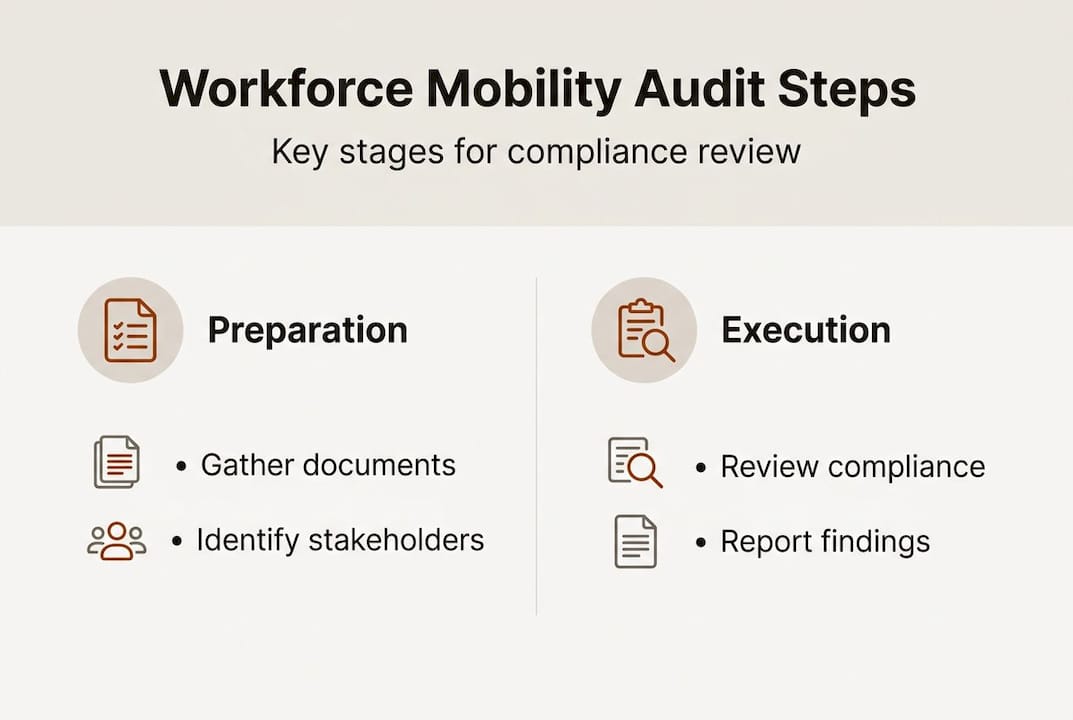
Once you understand what is at stake, the next step is to make sure each audit begins with thorough preparation. A well-prepared audit begins with assembling documentation, identifying roles, and aligning with mobility policies, and shortcuts at this stage consistently produce incomplete findings that undermine the value of the entire exercise.
The first task is to compile all relevant documentation for each relocated or posted employee. This should include:
- Employment contracts and assignment letters
- Work permits, visas, and residence permit copies with expiry dates
- Tax registration certificates and applicable double taxation treaty documentation
- Social security records and A1 certificates for posted workers
- Posted worker notifications filed in the destination country
- Payroll records confirming wages paid during the assignment period
The second task is to identify all stakeholders whose input the audit will require. Effective audits are cross-functional by design. HR, legal counsel, payroll, and mobility managers must each be assigned specific review responsibilities before the audit commences.
| Stakeholder | Primary audit responsibility |
|---|---|
| HR team | Employee records, contracts, and registration status |
| Legal counsel | Permit validity, regulatory alignment, and risk assessment |
| Payroll team | Wage compliance, tax withholding, and social security |
| Mobility manager | Assignment documentation and host country notifications |
Once stakeholders are identified, prepare a tailored audit checklist addressing Romania and EU-specific requirements. A generic checklist will miss jurisdiction-specific obligations. Reviewing relocation services best practices can help shape the checklist to reflect current operational standards.
Pro Tip: Use a digital tracking system to log each document for every relocated employee, with automated alerts for expiring permits, pending registrations, and overdue notifications. This reduces manual oversight failures, which are among the most common causes of audit findings.
Step-by-step audit procedure for workforce mobility
With all materials and stakeholders in place, you can now follow a structured procedure to ensure a thorough audit. Structured audit steps reduce errors and expose hidden compliance gaps that informal review processes routinely miss.
Each phase of the audit should be documented as it occurs, with findings recorded against specific employees, document types, or legal requirements rather than general program-level observations.
- Assess legal and compliance requirements. Review the applicable legal framework for each employee’s country of origin and destination, including any recent EU directive transpositions or Romanian legislative amendments effective in 2026.
- Review and verify all documentation. Cross-check work permits, visas, A1 certificates, social security records, and salary details against the requirements identified in the assessment phase. The immigration workflow optimization process should inform how documents are sequenced and verified.
- Conduct structured interviews. Speak with HR team members and a representative sample of relocated employees to validate compliance and capture undocumented processes that may not appear in written records.
- Identify and document findings. Record every instance of non-compliance, near-miss, or documentation inconsistency. Each finding should include the specific legal requirement implicated and the remediation action required.
- Recommend corrective actions. Prepare a prioritized improvement plan, distinguishing between critical remediation items (those that create immediate legal exposure) and lower-priority improvements.
Note that audit steps must be tailored to reflect different mobility scenarios, since the obligations governing a short-term posted worker differ materially from those applying to a long-term assignee or a permanent transfer.

| Mobility scenario | Key compliance focus areas |
|---|---|
| Short-term posting (under 12 months) | A1 certificate, host country notification, wage parity |
| Long-term assignment (over 12 months) | Host country labor law applicability, tax residency |
| Permanent transfer | Local employment contract, full registration |
Review the labor law audit process for additional guidance on structuring findings and remediation plans.
Pro Tip: During each audit cycle, review recent changes in EU and Romanian labor and tax legislation. Regulatory updates in 2026 may introduce new thresholds or notification requirements that affect existing mobility programs.
Troubleshooting and common audit pitfalls
Even with a robust process, mistakes happen. Being prepared for common pitfalls can make all the difference between a correctable internal finding and an enforcement action initiated by a competent authority.
The most frequently encountered audit failures center on the following issues:
- Expired or missing permits. Work authorization documents are often renewed late, particularly when assignment extensions are granted informally without triggering a formal administrative update.
- Absent posted worker notifications. Many EU member states require formal notification before a worker commences an assignment on their territory. Failure to file, or filing to the wrong authority, constitutes a standalone violation in many jurisdictions.
- Inconsistent payroll records. Discrepancies between employment contracts, payroll outputs, and tax filings signal either procedural failures or, in more serious cases, intentional underreporting.
- Overlooked EU directive updates. Documentation gaps and inconsistent application are leading causes of audit failure, particularly where companies have not systematically tracked directive transposition into national law.
- Undocumented salary adjustments. Ad hoc pay changes that are not reflected in formal contract amendments or payroll records create compliance exposure across multiple legal dimensions.
Companies operating across multiple EU jurisdictions should also monitor changes in salary calculation for mobility rules, which affect minimum wage compliance for posted workers.
“Most audit failures arise not from intent, but from lack of documentation and regular internal review.”
According to Nestlers Group, more than 60% of relocation compliance issues are discovered during internal audits, not external investigations. This statistic underscores the value of proactive internal review and the significant risk reduction that a structured audit program delivers to multinational organizations.
Verifying results and continuous improvement
Once the audit is completed, focus on long-term improvements and maintaining compliance. A completed audit that does not produce lasting procedural change provides only temporary assurance. Sustainable compliance requires that findings be translated into institutional improvements that persist across assignment cycles.
The post-audit phase should proceed as follows:
- Share audit findings and recommendations with senior management in a formal report that distinguishes between critical findings, moderate-risk items, and best-practice improvements.
- Launch corrective follow-up actions for each identified finding, assigning ownership to a named individual with a defined remediation deadline.
- Schedule regular mini-audits or spot-checks at quarterly intervals to monitor the effectiveness of corrective actions before the next full audit cycle.
- Update internal policies to reflect any legal or regulatory changes identified during the audit, ensuring that operational procedures remain aligned with current requirements.
Ongoing monitoring and regular follow-ups ensure sustained compliance and risk reduction, particularly in environments where legislative changes introduce new obligations at short notice.
The findings from each audit also generate valuable data for employee training programs. Patterns in audit findings reveal where procedural knowledge gaps exist across HR and payroll teams, and targeted training in those areas produces measurable reductions in compliance errors. Review mobility program audit insights for additional frameworks supporting post-audit improvement cycles.
Pro Tip: Use audit results to inform employee training and ongoing compliance strategies. Training programs developed from real findings are consistently more effective than those based on generic compliance modules.
Why most workforce mobility audits fall short—and what truly works
The prevailing weakness in workforce mobility audits is not a lack of checklists. It is the organizational tendency to treat the audit as a documentation exercise rather than a functional compliance assessment. Checklists confirm that documents exist. They do not confirm that processes work, that stakeholders understand their obligations, or that cross-functional coordination operates as intended when an edge case arises.
Organizations that achieve durable compliance approach audits differently. They test real-world processes, not just paper trails. They conduct cross-departmental sessions that surface coordination gaps between HR, payroll, and legal. They implement real-time digital records that reduce reliance on manual handoffs. They schedule recurring spot-checks rather than relying on annual reviews.
The value of regular immigration audits is amplified when audit programs are treated as ongoing operational functions rather than annual compliance events. Siloed roles and siloed processes are the primary structural barriers to effective audit outcomes, and no checklist, however detailed, resolves that fundamental problem.
Pro Tip: Build a culture of proactive mobility compliance within your organization. Reactive problem-solving after a regulatory inquiry is consistently more costly, in time, money, and reputational terms, than investing in systematic internal review.
Partner with experts for seamless mobility audits and compliance
For HR and compliance teams managing workforce mobility across Romania and the EU, the procedural complexity of audits often requires specialist support that goes beyond what internal teams can provide alone. Nestlers Group delivers compliance assurance specifically designed for Romanian and EU mobility contexts, covering every phase of the audit cycle. From initial documentation review and legal assessment through to corrective action planning and post-audit monitoring, the full range of mobility programs in the EU is supported. Explore dedicated immigration audit solutions or access the full portfolio of global mobility solutions to begin building a more resilient compliance program.
Frequently asked questions
What documents are needed for a workforce mobility audit in Romania?
Comprehensive documentation for each relocated employee is essential for compliance. Key documents include work permits, employment contracts, tax records, social security confirmations, and posted worker notifications filed in the destination country.
How often should HR conduct internal workforce mobility audits?
Annual audits are the standard recommendation, but regular audits mitigate compliance risks and uncover issues early, making semi-annual reviews advisable for organizations with high volumes of relocated or posted employees.
What is the most common compliance issue in workforce mobility audits?
Incomplete or outdated documentation, particularly expired permits and missing posted worker notifications, is the leading cause of compliance failures, as confirmed by audit failure analysis across multiple jurisdictions.
Can technology improve the audit procedure for workforce mobility?
Yes. Implementing a digital tracking system to log each document for every relocated employee streamlines documentation management, boosts accuracy, and simplifies ongoing compliance monitoring across multiple jurisdictions.
Recommended
Connect with Nestlers consultants
Do you need immigration and relocation services or consultancy?
It’s easy! Use the below contact form and one of our experts will provide you an answer as soon as possible.
Our consultants can help you in obtaining legal documents and can provide you with assistance regarding the immigration processes, relocation, taxes and payroll, Social Security (European forms A1, S1, U1, etc.) for your employees.